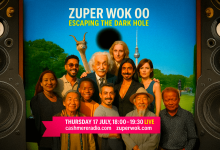
THE DARK HOLE #01
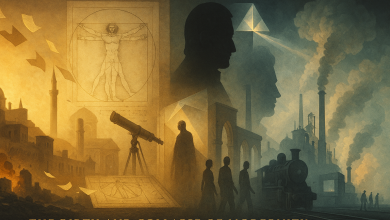
What happens when the man who built the modern world realizes that his laws are no longer enough?This episode of The Dark Hole is not a debate between two scientists. It is a moment of passage.Inside a black hole — where time slows, where light cannot return — Isaac Newton meets Albert Einstein, guided by Simone Weil. What unfolds is neither confrontation nor defeat, but something rarer: recognition.Newton arrives as the architect of certainty. A world governed by laws, forces, equations that explain and reassure. A universe that behaves.But very quickly, something shifts.
“Then everything I knew was incomplete.”
This sentence is not a collapse. It is a liberation.Einstein does not destroy Newton’s world. He places it. He shows that Newton was right — locally. That his laws still work in calm spaces, at human scale. But near massive stars, near the speed of light, near the edge — thought must bend.“Not wrong. Just a local truth.”
What makes this moment powerful is Newton’s reaction. There is no bitterness. No defensive pride. Instead, something childlike appears — curiosity, relief, wonder.“I once said I felt like a boy playing on the shore of the ocean of truth. I now see the ocean is deeper than I imagined.”
Here, modernity does not shatter. It softens.Einstein pushes further, not into arrogance, but into humility. Even his own vision has limits. He never unified gravity and the quantum world. Mystery remains — and that is where beauty lives.“There is still mystery. And that is where beauty lives.”
Simone Weil holds the space. She does not rush to explain. She lets silence do its work. She reminds us that this meeting is not only about physics, but about vision — how humans relate to the world when certainty dissolves.The black hole becomes a stage for a deeper shift:from laws to relations from objectivity to position from domination to participation
Einstein names it clearly:“We are no longer dealing with things. We are dealing with relations.”
And Newton, instead of resisting, opens:“I thought I was at the end of something… but now I see. I was only at the beginning.”
This is the heart of The Dark Hole.Not the victory of the new over the old. But the joy of discovering that reality is more alive, more complex, more playful than expected.The episode closes on a quiet truth: ideas do not die when their bodies disappear. They live on as questions, as curves carved into thought.“A thought can bend time. A question can mark the night sky like a comet.”
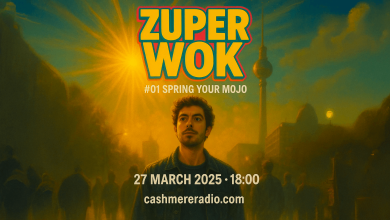
The Dark Hole #01 is an invitation to stand at the edge — not to conquer the unknown, but to play with it again, like a child.Extracted from ZUPER WOK, broadcast on Cashmere Radio.