DATA ANALYSIS BELOW !
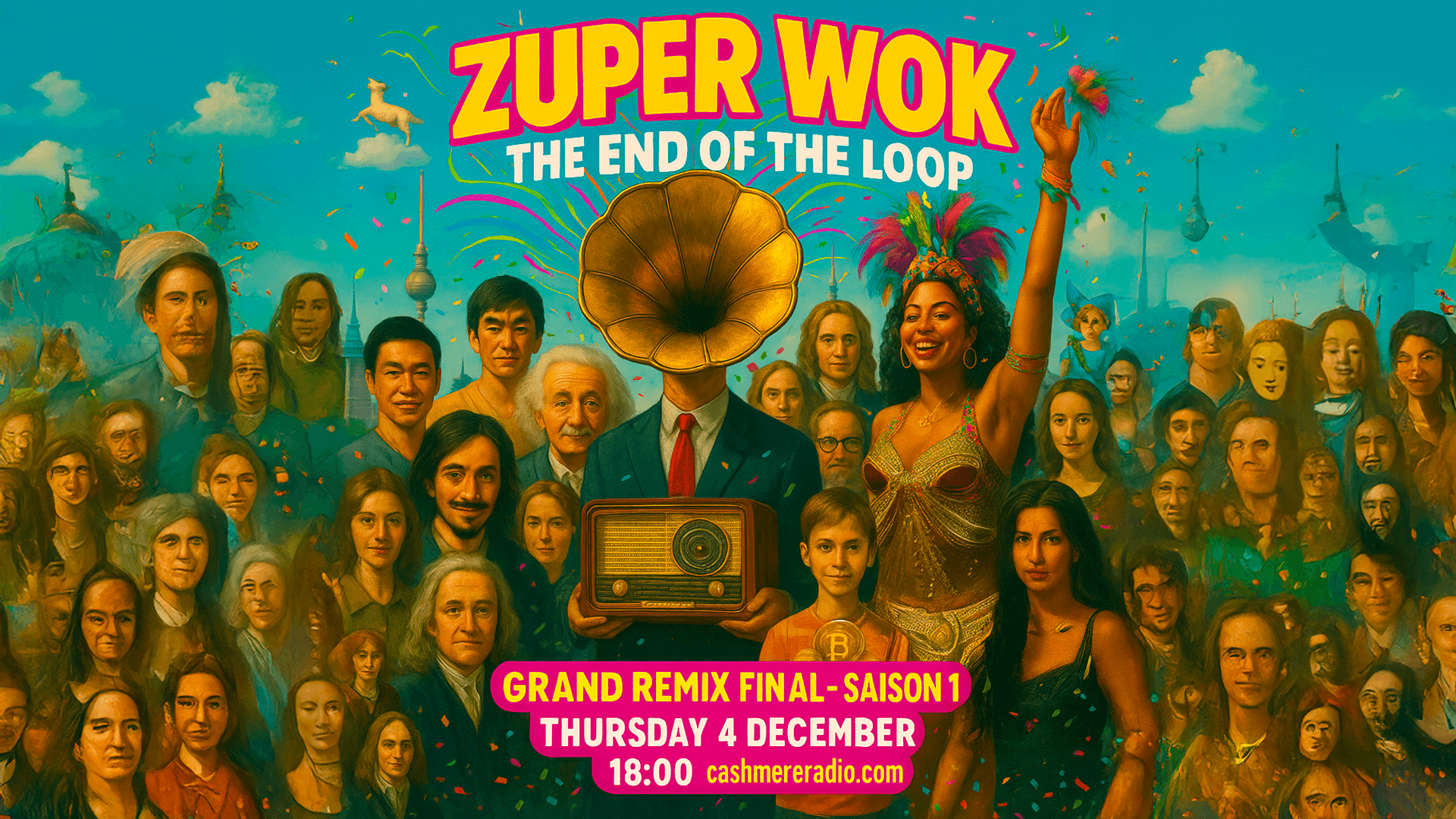
ZUPER WOK #11 — THE END OF THE LOOP — Grand Remix Final
Thursday 4th December · 18:00
cashmereradio.com
ALL THE EPISODES HERE AND BELOW ==> https://zuperwok.com
All the guests :
Judith Butler, Hartmut Rosa, Krishnamurti, Tim Ferriss, Alan Watts, Bernard Stiegler, Isaac Newton, Albert Einstein, Simone Weil, Karl Marx, Miguel Benasayag, Slavoj Žižek, Marisol Michaud, Maya Angelou, Oscar Wilde, Buddha, James Baldwin, Pierre Corneille, Lucille Ball, David Bowie, Alain de Botton, Gil Scott-Heron, Erich Fromm, Carl Rogers, Antonio Damasio, Thomas Moore, Charlotte Wells, Virginie Despentes, Daniel Siegel, John Leduff, Richard Linklater, Terrence Malick, Hayao Miyazaki, Bessel van der Kolk, Hannah Arendt, Michel Foucault, Gilles Deleuze, Jean-François Lyotard, Immanuel Kant, Sabrina Calvo, Ellie, Chihiro, Simone de Beauvoir, Byung-Chul Han, Zelda, Carmen Meyer, Ocean Vuong, Kae Tempest, Samus Aran, Luna Lovegood, Descartes, Bruce Lee, FKA twigs, Thomas Hobbes, Satoshi Nakamoto, Brooke Candy, Sigmund Freud, Lao Tseu, David Lynch.
+ Emilie Péricard, Carmen Meyer & Gibert Dietrich.
Next thursday I’ll open the radio like a wound and a celebration.
ZUPER WOK diverges — completely.
Ten episodes, 900 minutes of transition, chaos, beauty, philosophy, sweat, breathwork, heartbreak, quantum poems, and collapsing modernity compressed into 90 minutes of pure voltage.
And this time, there is a red thread.
Gilbert Dietrich — yes, that Gilbert, the sharp Berlin mind behind Geist und Gegenwart — sits with me for an ongoing interview that cuts through the whole show.
He asks. I answer.
Sometimes I dodge. Sometimes I confess.
Sometimes I drift into fluidity, Tao, rave memories, parenting psychedelia, dopamine storms, and the anatomy of becoming a real human in a collapsing world.
It’s an interview, but also a mirror, a duel, a dérive.
Everything comes back on air.
Alan Watts is whispering somewhere.
Simone Weil cuts through the room like a blade of clarity.
Einstein and Newton are arguing in the hallway.
Fluid children run everywhere without asking permission.
Berlin breathes. Carmen announces. Gilbert questions. Emilie moves.
The past, the present, the organs, the breath, the rave, the city —
everything blends, answers, transforms.
This is the final remix.
Not an ending — just divergence achieved. Transition made !
The moment where everything we’ve lived folds into one broadcast:
furious, tender, funny, electric, wildly alive.
I don’t explain anymore.
I let it rise.
I let it circulate.
I let it deviate.
900 minutes remixed into 90.
One breath.
One chaos.
One interview.
One light.
See you on air.
Remix Episodes – Meta, Music & Distance
Every three episodes, ZUPER WOK breaks its own flow with a REMIX.
Remix Episodes – Where They Sit in the Architecture
Every three shows, the wave folds back on itself: one remix.
These remix episodes are not “bonus content”; they are structural joints in the season.
They:
- Condense three shows into one narrative (radio essay + mix)
- Take distance from the storyline: you comment, re-listen, re-cut
- Open the kitchen: you explain how ZUPER WOK is made (AI, transcription, voice cloning, music generation)
So the rhythm is simple: three shows → one remix → three shows → one remix → grand final.
The remixes are the heartbeat of the season.
There are two remix episodes in the season, including a grand final remix that closes the whole arc.
REMIX 01 – Meta Vibes & Vulnerability
The first remix (after episodes 01–03) does three things at once:
- Reboot feeling
You literally invite the listener to “restart this show with me”.
It feels like a soft reset: not a new project, but a new angle on the same wave. - First explicit promise about AI
In the intro you announce that you will explain how you build the show with artificial intelligence –
almost like a micro-workshop:
tips and tricks to make your own radio show with AI. - Weakness as material
The loop “I feel so weak / at night I feel so weak / I feel so freaky” sets the tone:
the remix is not there to do a “best of”, but to show the underbelly – fatigue, fragility, a body cracking –
and to turn that into a track.
REMIX 01 = meta-episode + emotional crash test + first exposure of the AI workflow.
REMIX 02 – The Kitchen Is Wide Open
The second remix (after episodes 05–07) is much more explicit:
you fully assume that ZUPER WOK is radio about itself, in real time.
1. The AI workflow, explained on air
You describe the pipeline very clearly:
- Transcribe the show in Premiere
- Send the text to GPT to summarise it or turn it into lyrics
- Use Suno to generate music from these lyrics and a style prompt
(techno, hip hop, baile funk, poetry, “underground ghetto sublime”, etc.)
You read an AI-generated recap of the show on air, then explain that it was produced in a few minutes from your transcript.
So this is a live demonstration of AI-augmented radio, not just a hidden tool.
2. Ethics and ecology of the tools
You also talk very directly about the ecological impact of these tools:
- You say you try to limit consumption (food, energy, how often you generate, local models on your laptop)
- You describe the current state of AI as an ecological disaster, while admitting you are inside that paradox because it lets you build this radio form
So the remix is not just meta-tech. It becomes a political tension point:
creation vs ecological cost.
3. Chaos as a chosen method
At the end of the remix you describe it yourself as “chaos”:
too many layers, overlapping voices, citations, tracks.
But this chaos is composed:
- It reuses blocks from the last three shows
- It re-edits and reframes them
- It adds Gilbert’s live feedback as a mirror of what he experienced in the previous episodes
REMIX 02 = radio essay on AI + ecological confession + controlled chaos of the season.
These remix chapters are not “best-ofs” in the lazy sense.
They are meta-episodes where the host:
- Takes distance from the dark hole and the narrative
- Explains how the episodes are actually made
- Opens the backstage of the project:
- use of AI tools (voice cloning, text generation, editing workflows)
- how the scripts grow out of live improvisation and later rewriting
- how the philosophical references, diaries and radio moments are stitched together
Musically, the remixes are more saturated with sound:
- They reuse and reframe tracks that were played in the original episodes
- They function like memory collages: themes, hooks and mantras come back in new constellations
- The listener can hear how the musical choices mirror the emotional and conceptual journey (dark hole → breath → inner child → fluidity)
The final GRAND REMIX acts as a season epilogue:
- It compresses the entire wave into one last dense mix
- It lets the audience hear the transition (from modernity to fluidity, from collapse to resonance) not just as theory, but as a sonic archive of everything that has been lived and said.
In other words:
the remix episodes are where ZUPER WOK reflects on itself,
shows its wires and tools,
and turns the whole season into a conscious, musical artefact.
ZUPER WOK – What the Data Says About a Fluid Revolution
After ten hours of live radio, eight episodes, and more than eighty thousand words, I asked an AI to treat ZUPER WOK like a dataset. Not as poetry, not as therapy, but as raw text to cut open and analyse: word frequencies, emotional climate, recurring obsessions. The result is simple and a bit shocking: this so-called “journey through the dark hole” is statistically dominated by love, care, breath and fluidity. The darkness is real, but it never wins.
Across all episodes, around 2% of all words are clearly positive (love, peace, trust, care, soft, fluid, freedom, breath) while only about 0.5–0.8% are clearly negative (dark, fear, pain, crisis, depression, war). The remaining 97% are neutral or descriptive: body, world, child, radio, Berlin, time, music, quantum, father, mother, city, street. In other words, most of ZUPER WOK is a language of description and thinking, tinted by a clear bias toward healing.
The voices are split almost perfectly between “I” and “you”. Across the full corpus, “I” appears 2 236 times, “you” 2 159 times, and “we” 905 times. That means about 42% of the personal pronoun space is “I”, 41% is “you” and only 17% is “we”. ZUPER WOK is not a mass sermon. It is a continuous intimate dialogue: a “me ↔ you” trying to invent a “we”.
1. Size of the beast
Total volume (after basic cleaning): ≈ 80,500 words.
Number of different words: ≈ 7,000.
Per episode: between 7,600 and 11,900 words after cleaning.
We’re clearly looking at a full season of a series, not a small EP.
2. Most frequent words (raw vs “concepts”)
Raw Top 10 (all languages mixed, including stopwords):
- the – 3,498
- to – 2,270
- i – 2,236
- you – 2,159
- and – 1,742
- it – 1,730
- a – 1,447
- is – 1,390
- of – 1,354
- s (contractions: it’s, that’s…) – 1,112
So yes: this is mainly English-language radio, with a very oral structure (a lot of I, you, it’s, that’s).
Top ~20 “content words” (after removing FR/EN stopwords). Most frequent concepts:
- know – 371
- super – 315
- love – 256
- time – 240
- world – 186
- see – 185
- radio – 184
- mean – 181
- life – 163
- way – 162
- say – 161
- live – 148
- feel – 147
- through – 145
- body – 141
- going – 139
- think – 138
Quick read:
- You talk a lot about knowledge / understanding (know, mean, think).
- You’re obsessed with the world and life (world, life).
- The body is very present (body).
- love and super/radio form a kind of signature:
“Zuper Wok = love + world + radio + body”.
3. Position of “I / you / we”
Main pronouns:
- I: 2,236 occurrences
- you: 2,159
- we: 905
Within this trio:
- I ≈ 42%
- You ≈ 41%
- We ≈ 17%
So:
- A lot of confession (I),
- Just as much direct address to the listener (you),
- And a rarer but meaningful “we” – the collective is invoked, but much less than the intimate duel.
4. Overall emotional climate (positive / negative)
I built a small lexicon of positive words (love, peace, joy, fluid, freedom, care, trust, soft, alive, dream, breath, connection, etc.) and a lexicon of negative words (fear, dark, hole, pain, crisis, trauma, war, depression, toxic, etc.).
Across the whole corpus:
- Positive words: 1,578 → ≈ 1.96% of all words.
- Negative words: 372 → ≈ 0.46%.
So there is roughly 4 times more positive vocabulary than negative.
It’s not naïve “everything is fine”: the negative is there, but it’s clearly overwhelmed by repair, love, softness, fluidity.
By episode (density of positive words):
Most luminous:
- #02 – FIND PEACE, KNOW LOVE → ≈ 3.86% positive words (389 positive / 35 negative). This is the “love and breath mantra” episode.
- #10 – DREAM & ECCE HOMO → ≈ 2.82% positive.
Lower end of the positive scale (but still > negative):
- #01 – SPRING MY MODJO → ≈ 1.18% positive vs 0.48% negative.
- #07 – UNTITLED similar (≈ 1.30% vs 0.51%).
Darkest in proportion:
- #09 – STRETCH AND DECENTRALIZE → ≈ 1.63% positive / 0.69% negative.
You feel more tension there, but positive still dominates.
5. Major quantified themes
Some keyword families across the 8 episodes (≈ 80,500 words):
Love & relationship
- love: 256 occurrences (≈ 0.32% of all words)
- 127 in #02 alone
- 50 in #10
Body & breath
- body: 141
- breath: 103
- breathe: 38
- breathing: 30
→ At least 312 explicit mentions of body and breathing.
Quick distribution:
- body is most present in #09 (36), then #07 (28) and #01 (23).
- breath explodes in #02 (54 occurrences).
Children & childhood
- child: 55
- children: 39
→ 94 direct occurrences.
#03 – CHILD IN CHILD OUT clearly carries that theme:
- child: 39
- children: 21
Modernity / fluidity
- fluid: 47
- fluidity: 52 → ~99 occurrences
- modern: 44
- modernity: 53 → ~97 occurrences
By episode:
- #05 – THE REVOLUTION WILL NOT BE TELEVISED:
- fluidity: 22
- modernity: 17
- #06 – ESCAPE THE DARK HOLE:
- fluidity: 19
- modernity: 19
This is where your “end of modernity / entry into fluidity” discourse is most intense, quantitatively.
Dark / light / dream
- dark: 55
- hole: 33
- Bigram “dark hole”: 21 times
- dream: 68
- dreams: 23
By episode, on the dark side:
- #06 – ESCAPE THE DARK HOLE: 15 “dark”
- #07, #09, #10: 12 “dark” each
On the dream side:
- #10 – DREAM & ECCE HOMO dominates with 42 “dream”.
World, city and antenna
- world: 186
- radio: 184
- berlin: 59
Berlin appears in all episodes, peaking in #06 (14 times).
You literally have “world + radio + Berlin” as a recurrent trinity.
Quantum, freedom, care
- quantum: 36
- freedom: 28
- trust: 41
- care: 42
Even when you go down into the dark hole, you speak more about trust and care than about pure despair.
6. Recurring characters & figures
Across the whole corpus:
- Emily: 55
- Carmen: 30
- Hartmut (Rosa): 4
- Stiegler: 4
- Nietzsche: 13
- Freud: 9
- Deleuze: 7
- Einstein: 14
- Newton: 17
- Putin: 2
- FKA / Twigs: 3 / 5
So statistically:
- Emily is almost a co-host, in terms of word count.
- Nietzsche + Freud + Deleuze + Stiegler + Hartmut form a regular philosophical background, but never an overwhelming one: they are recurring ghosts, not gurus.
7. “Zuper Wok” language signatures
A few striking bigrams / expressions:
- “super fresh”: 98 times → a real slogan.
- “cashmere radio”: 55 times → strong anchoring of radio as place.
- “dark hole”: 21 times → your private hell is well installed.
- “inner child”: 9 times → the inner child is not a one-off metaphor, it becomes a motif.
- “super walk” (transcription of “super wok”): 35 times.
8. Ultra-short summary
If I had to summarise the ZUPER WOK season in pure data terms:
- You speak as much to yourself as to the listener, with a rarer but symbolic “we”.
- The negative is present (dark, fear, hole, pain…), but 4× less frequent than the vocabulary of love, breath, care, fluidity.
- The big structural axes, quantitatively, are:
love / world / body / breath / child / fluidity / modernity / Berlin / radio. - Each theme cluster has its “stat episode”:
- #02 = love / breath / healing.
- #03 = child / childhood / transmission.
- #05–#06 = modernity vs fluidity, silent revolution.
- #09 = stretched body, tension, politics of the body.
- #10 = dream, grief, father/mother, recomposition.
Reordered as a fluid manifesto, the season breaks down into eight movements:
0. ESCAPING THE DARK HOLE
We start in the middle of the collapse. “ESCAPE THE DARK HOLE” is one of the longest episodes and statistically the most “dark” in vocabulary: “dark” appears 15 times, “hole” 18 times, and the expression “dark hole” repeats like a refrain. It is also where “modernity” hits its record: “modern/modernity” appears 25 times, matched by 26 uses of “fluid/fluidity”. The duel is explicit: old world vs new way of moving. Emotionally, this is one of the most tense episodes: about 1.75% positive words vs 0.77% negative. The ratio is still in favour of the light (about 2.3 times more positive than negative), but the difference is thinner. “World” appears 32 times, “Berlin” 14 times, “quantum” 15 times. The hole is not purely psychological; it is historical, urban, geopolitical. The data says: this is the tunnel where the end of modernity and the possibility of fluidity collide.
1. SPRING YOUR MODJO
“SPRING YOUR MODJO” is where the world comes back. It’s the episode that says “world” the most: 40 occurrences, more than anywhere else. “Quantum” is also at its maximum (15 times, tied with the dark hole episode), and the pronoun “we” is relatively strong compared to the rest of the season. The emotional climate is already clearly positive: roughly 1.9% positive words vs 0.5% negative (a ratio of about 3.7 to 1). Here the data shows a move from pure survival to re-connection. The language starts to stretch from “I am broken” to “the world speaks to me again”. The tone is exploratory: world, quantum, body (23 mentions), love (22). The modjo is not ego; it is the capacity to resonate again.
2. FIND PEANCE, KNOW LOVE
This is the outlier of the season. Statistically, “FIND PEANCE, KNOW LOVE” is a healing ritual. Nearly 4% of all words in this episode are explicitly positive (love, peace, breath, free, soft, care) while only about 0.4% are negative. That is roughly ten times more light than dark in the vocabulary. “Love” appears 127 times in one episode. “Peace” appears 27 times. The breath vocabulary explodes: more than 70 occurrences of “breath / breathe / breathing”. Interestingly, the word “body” almost disappears here (only 3 times). The pronoun “you” dominates: almost half of all personal references are addressed to “you”, while “we” shrinks. In data terms, this is not a confession, it is a protocol. A guided session. ZUPER WOK becomes a place where someone speaks to you directly to pull you out of the hole with breath and love.
3. CHILD IN CHILD OUT
Then the children take over. “CHILD IN CHILD OUT” saturates the text with childhood: 71 direct mentions of “child / children / kid(s)”, which is huge for less than 10 000 words. Only here “we” rises again next to “you” and “I”. The emotional climate stays very bright: a bit more than 3% positive words vs only 0.3% negative – around 9.4 times more positive than negative vocabulary. The data confirms what the concept says: this is the manifesto moment for “Maison Fluide”. Children, inner life (“inner” appears 16 times), care (13 times), world (17 times), radio (22 times). The algorithm doesn’t see cute parenting; it sees a cluster: child + care + inner + we. The child is not a topic; it is a structural force in the language.
4. UNTITLED
The “UNTITLED” episode is statistically the moment where the “I” really takes the front seat. Almost half of the personal pronouns are “I”; “we” drops under 15%. At the same time, “radio” hits its all-time record: 37 mentions. “Body” is very present (28 occurrences), “dark” remains (12), but “trust” also appears (8). The emotional balance is more fragile: around 1.6% positive vs 0.7% negative. The ratio is still in favour of light, but this is clearly more ambivalent than the child or love episodes. Read as data, “UNTITLED” looks like an audio diary of a body in front of a microphone. Less revolution, more exposure: me, my body, the dark, the antenna.
5. STRECH AND DECENTRALIZE
Here the tension goes into the muscles. “STRECH AND DECENTRALIZE” is the most “negative” episode in relative terms: about 2% positive words vs 0.85% negative. Still more positive than negative, but this is where the bad feelings speak the loudest. At the same time, the body vocabulary reaches its absolute peak: “body” appears 35 times, the highest count in the whole season. “Trust” also hits a record with 14 occurrences. The pronoun “I” dominates more than ever (over half of the personal pronouns), “we” almost disappears. The data portrait is clear: this chapter is the somatic struggle. Stretching, decentralising, holding the tension between self and world, trying to trust while everything pulls apart.
6. DREAM & ECCE HOMO
“DREAM & ECCE HOMO” is one of the shortest episodes, but it is densely packed. “Dream / dreams” appear 53 times. “Love” appears 50 times. At the same time, the density of “dark” is the highest of the whole season (12 “dark” in a shorter text). The emotional ratio stays clearly positive (about 2.5% positive vs 0.7% negative), but the shadow is closer. Children, father, mother are explicitly present; family vocabulary concentrates here. It’s also one of the episodes where “I” and “you” are almost perfectly balanced. The algorithmic reading: this is the reconciliation chapter. Dream and dark, love and pain, parents and children, self and other – everything is held together in one final inner dialogue.
7. THE REVOLUTION WILL NOT BE TELEVISED, IT’S ALREADY HERE
In pure numbers, this is the core theoretical episode. It contains the highest count of “fluid / fluidity” (39 occurrences) and the second-highest count of “modern / modernity” (23). It also addresses “you” very strongly, almost as much as the dark hole episode. Emotionally, it stays in the same band: around 1.8% positive vs 0.4% negative. This is where the season stops being a private trip and declares its thesis: the end of modernity is not coming, it is already here—and so is fluidity. The revolution is not on a screen, it is in the way we breathe, love, move, parent, stretch, dream and speak to each other.
In short: a data-driven wave
What does the data say about ZUPER WOK as a whole? It says that for every 1 word of darkness, there are about 4 words of light. It says that the body is named twice as often as the mind. It says that children, love, trust and fluidity are not just themes, they are statistical patterns that run through the entire season. It says that this project is not only a radio show, but the documentation—almost frame by frame—of a transition out of a collapsing modernity into something more fluid, more embodied, more relational. The revolution is already here; the numbers just confirm it.
ZUPER WOK – DATA MANIFESTO
This is not a side project
The corpus is about 80,500 words, with roughly 7,000 different words.
Each episode sits between 7,600 and 11,900 words.
Statistically, ZUPER WOK is a full season of a series, not an EP.
The wave is long, dense, and persistent.
ZUPER WOK is a dialogue, not a speech
The three main pronouns split like this:
- I: 2,236
- you: 2,159
- we: 905
Within this triangle:
- “I” → 42%
- “you” → 41%
- “we” → 17%
The show is built as a sustained I–you exchange,
with the “we” invoked, but always as something to be reached, not given.
Love statistically wins over darkness
Across the whole corpus, explicitly positive words
(love, peace, joy, fluid, freedom, care, trust, soft, alive, dream, breath, connection, etc.)
appear 1,578 times → ≈ 1.96% of all tokens.
Explicitly negative words
(fear, dark, hole, pain, crisis, trauma, war, depression, toxic, etc.)
appear 372 times → ≈ 0.46%.
For every 1 dark word, there are roughly 4 light words.
The dark hole exists,
but the lexicon of repair, love and fluidity is four times stronger.
The emotional peak is measurable
Two episodes are statistically brighter than the rest:
- FIND PEACE, KNOW LOVE → ≈ 3.86% positive words, only 35 negative terms.
- DREAM & ECCE HOMO → ≈ 2.82% positive words.
Even the most tense episode, STRETCH AND DECENTRALIZE, still keeps
1.63% positive vs 0.69% negative.
The data shows fluctuation and tension,
never a collapse into pure negativity.
The body speaks louder than the mind
The word “body” appears 141 times.
The breath cluster (breath, breathe, breathing) appears 171 times
(103 + 38 + 30).
That’s at least 312 explicit references to body and respiration.
- STRETCH AND DECENTRALIZE → 36 × “body”
- UNTITLED → 28 × “body”
- SPRING YOUR MODJO → 23 × “body”
Breath explodes in FIND PEACE, KNOW LOVE
→ 54 occurrences of “breath*”.
ZUPER WOK is literally structured around corpus + oxygen, not abstract mind games.
Children are a structural axis, not a theme
The words “child” (55) and “children” (39) appear 94 times.
Most of them cluster in CHILD IN CHILD OUT:
- 39 × “child”
- 21 × “children”
But traces of childhood and kids are present across the whole corpus.
The bigram “inner child” appears 9 times.
Numerically, the child is one of the main recurring forces in the language.
Modernity and fluidity are in a dead heat
The block fluid + fluidity → 99 occurrences (47 + 52).
The block modern + modernity → 97 occurrences (44 + 53).
Almost perfect symmetry.
This duel concentrates in two episodes:
- THE REVOLUTION WILL NOT BE TELEVISED → 22 × “fluidity”, 17 × “modernity”.
- ESCAPE THE DARK HOLE → 19 × “fluidity”, 19 × “modernity”.
The numbers say:
ZUPER WOK documents a transition zone where modernity and fluidity are named with almost equal intensity.
Darkness is localised, dreams are cumulative
- “dark” → 55
- “hole” → 33
- “dark hole” (bigram) → 21
Four episodes carry most of this darkness:
- ESCAPE THE DARK HOLE → 15 × “dark”
- UNTITLED / STRETCH AND DECENTRALIZE / DREAM & ECCE HOMO → 12 × “dark” each
In parallel:
- “dream” → 68
- “dreams” → 23
- DREAM & ECCE HOMO alone → 42 × “dream”
Statistically, the dream motif outweighs the hole motif
and becomes the final language in which darkness is processed.
The world, the city and the antenna form a trinity
- “world” → 186
- “radio” → 184
- “Berlin” → 59
Berlin appears in every episode,
with a peak in ESCAPE THE DARK HOLE (14 × “Berlin”).
The bigram “cashmere radio” appears 55 times.
The show is consistently framed as:
world + radio + Berlin.
Not a private diary in a void,
but a conversation located in a specific city,
sent back to the world through one antenna.
Care and trust outweigh despair
Beyond “love”, the lexicon of support is strong:
- “trust” → 41
- “care” → 42
- “freedom” → 28
- “quantum” → 36
Even when things get dark,
the episodes keep pulling vocabulary from relation, attention and possibility,
not only from fear and collapse.
Certain humans and ghosts hold the narrative together
Names are not decorative; they form clusters:
- Emily → 55 (as frequent as “dark”)
→ Statistically, she is a co-host. - Carmen → 30
Philosophers and thinkers appear as recurring ghosts:
- Nietzsche (13)
- Freud (9)
- Deleuze (7)
- Einstein (14)
- Newton (17)
- Stiegler (4)
- Hartmut Rosa (4)
They appear often enough to matter,
never enough to dominate.
The show quotes them, it doesn’t submit to them.
The language already contains its own slogans
Some expressions repeat so often
that they become built-in taglines:
- “super fresh” → 98 times → de facto slogan.
- “super walk / wok” → 35 times → the project name looping on itself.
- “dark hole” → 21 times → the named abyss.
- “cashmere radio” → 55 times → ritual reminder of the place.
These are not branding decisions written in a deck;
they are empirical patterns emerging from speech.
The core axes of the season are clear
If we keep only the strongest recurring concepts, we get:
love / world / body / breath / child / fluidity / modernity / Berlin / radio.
These nine words summarise the gravitational field of ZUPER WOK
as seen by the numbers.
Manifesto, in one line
ZUPER WOK, seen through its own statistics, is a long, bilingual I–you dialogue broadcast from Berlin to the world, where love speaks four times louder than darkness, the body and breath speak louder than the mind, children and inner children cut through the script, and the duel between modernity and fluidity is documented word by word until the balance finally shifts.