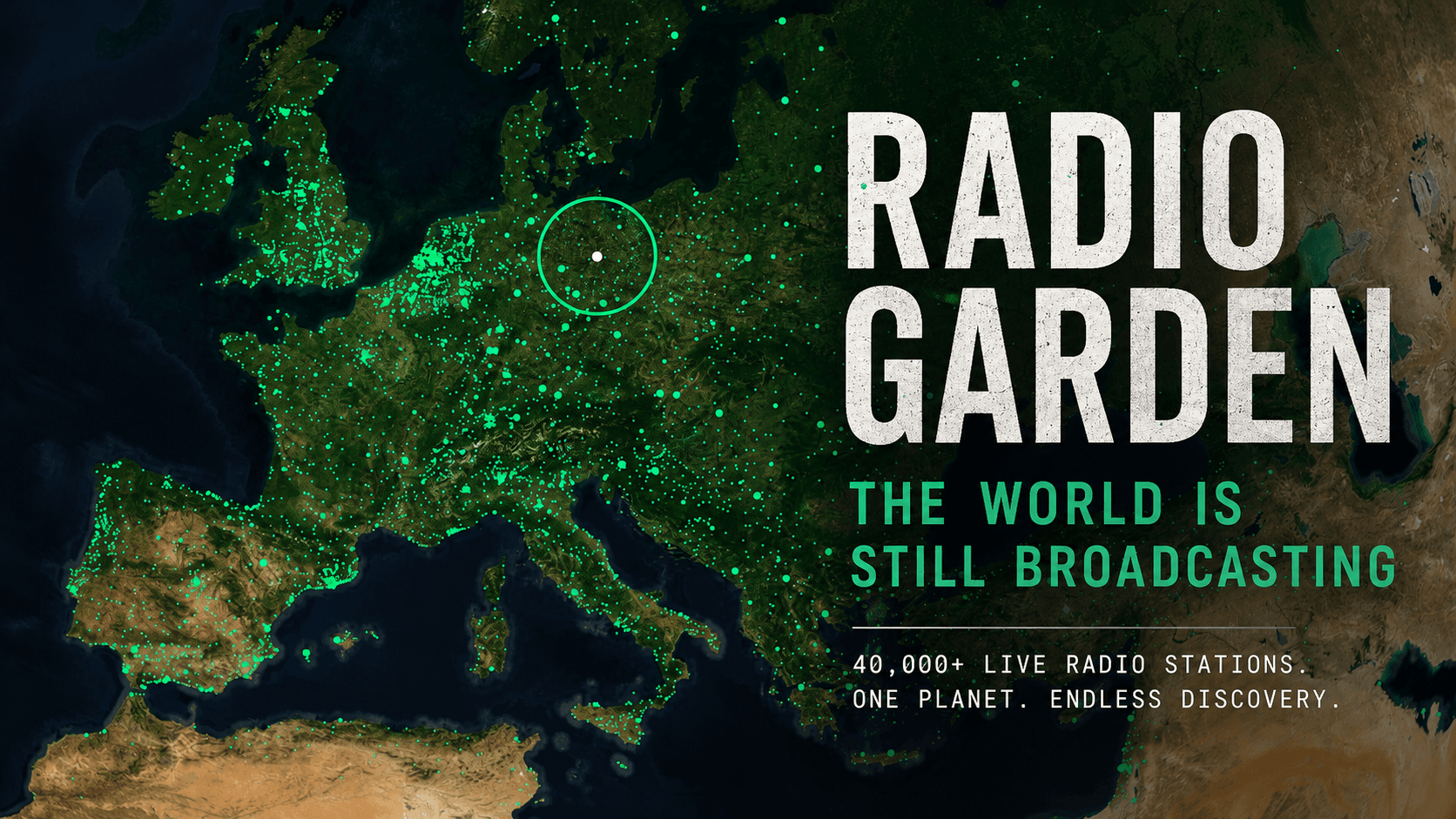
There are tens of thousands of web radios broadcasting around the world right now. Some transmit from professional studios, others from clubs, record stores, universities, bedrooms, galleries, cultural spaces or tiny community organisations. They play music, conversations, field recordings, experimental programmes and local voices for audiences that sometimes number in the thousands and sometimes in the dozens. The strange thing is that, despite more than twenty years of web radio, there are still very few places where you can actually find them. Radio Garden is one of them.
Open Radio Garden and the Earth appears in front of you, covered with thousands of green dots. Move across the planet, stop somewhere and a radio starts playing. Berlin, Dakar, Tokyo, Marseille, Detroit, Reykjavík, São Paulo, Tbilisi or a town you have never heard of before: every dot opens a small window into a place.
The idea is beautifully simple, but what Radio Garden has created is more important than its interface suggests. It has given internet radio something it has always desperately needed.
A place to exist.
WEB RADIO HAS A DISCOVERY PROBLEM
Creating an internet radio station has become remarkably accessible. A computer, a microphone, some broadcasting software and a streaming server can be enough to start transmitting. Thousands of independent stations have appeared this way, alongside FM and DAB broadcasters that now also stream their programmes online.
Finding them remains surprisingly difficult.
Search for radio online and the same familiar names tend to dominate. Traditional radio aggregators, search engines, smart speakers and streaming platforms naturally surface established broadcasters, major networks and stations with strong audiences or powerful brands. The online stream of an existing FM station is relatively easy to find because people already know what to search for.
A tiny independent web radio has a completely different problem.
You need to know that it exists before you can search for it.
A station can have brilliant programming, extraordinary selectors and a functioning 24-hour stream while remaining almost invisible outside its immediate community. Its website becomes a small island somewhere on the Internet.
Radio Garden connects those islands.
MORE THAN 40,000 RADIOS ON ONE PLANET
Radio Garden began in 2016 as part of Transnational Radio Encounters, a European research project exploring how radio crosses geographical, linguistic and cultural boundaries. What started as an experimental interface gradually became a permanent platform operated independently by Jonathan Puckey from Amsterdam.
Today Radio Garden maintains a collection of more than 40,000 stations around the world.
The number matters, but the way those stations are presented matters even more.
Radio Garden does not begin with a list of famous broadcasters. It begins with geography.
You see Earth.
Every available location becomes a green dot, and every dot becomes an invitation to listen.
This simple decision changes the hierarchy of radio.
THE SMALL WEB RADIO AND THE NATIONAL STATION SHARE THE SAME MAP
This may be Radio Garden’s most radical feature.
On most platforms, visibility is organised through popularity, brand recognition, search ranking, audience size or recommendation systems. The biggest stations naturally occupy the most visible positions.
On Radio Garden, geography becomes the organising principle.
A huge national broadcaster and a strange little web radio run by four people can exist within the same city and appear inside the same interface. The difference in their marketing budgets suddenly becomes much less important.
They both become radio stations.
This is particularly valuable for independent web radio because the medium has always been fragmented. There is no universal FM dial for the Internet. There is no physical frequency band where you can slowly turn a knob and accidentally discover a station broadcasting from someone’s studio three streets away.
Radio Garden effectively builds that dial.
Except the dial is the Earth.
TURN THE WORLD UNTIL SOMETHING HAPPENS
The interaction recreates one of the great pleasures of traditional radio: accidental discovery.
With an analogue receiver, you turned the dial without necessarily knowing what you were looking for. Static disappeared and suddenly there was music, a conversation or a voice speaking another language.
Radio Garden translates that behaviour into geography.
Instead of moving from 88 to 89 MHz, you move from Berlin to Warsaw, from Warsaw to Istanbul, from Istanbul to Beirut and then perhaps across the planet to Mexico City.
The algorithm is remarkably simple.
Your curiosity.
This is very different from the logic that dominates contemporary streaming. Spotify, YouTube, TikTok and other platforms become increasingly sophisticated at predicting what might keep us listening. Radio Garden gives us a planet and lets us get lost.
A DIRECTORY YOU CAN ACTUALLY EXPLORE
This is why describing Radio Garden as a radio aggregator feels insufficient.
A traditional directory gives you a database and asks you to search it.
Radio Garden turns the database into a territory.
That distinction becomes crucial when dealing with tens of thousands of stations whose names you have never encountered. Search works beautifully when you know what you want. A map works when you have absolutely no idea.
You can decide that tonight you want to hear what is broadcasting from Athens. You can explore stations in Johannesburg. You can travel across South America one city at a time. You can discover an experimental station because its green dot happened to sit underneath your cursor.
For web radio, this is an extraordinarily appropriate form of discovery because the medium itself is built from countless independent communities scattered around the planet.
Radio Garden makes that network visible.
IF YOU RUN A WEB RADIO, PUT IT ON THE MAP
There is another reason Radio Garden deserves more attention from independent broadcasters: you can submit your own station.
Radio Garden provides a station submission process for broadcasters wishing to join the map. A station needs a functioning online stream and the information required to identify and locate it. The Radio Garden team reviews submissions before adding eligible stations to the service.
For anyone running a web radio, this should become one of the basic steps of launching a station.
Create the stream.
Build the website.
Establish the identity.
Start broadcasting.
Then put the station on Radio Garden.
A web radio lives through circulation. Every additional place where a listener can encounter the stream creates another entrance into the project, and Radio Garden offers something particularly valuable because people visit it specifically to discover stations they do not already know.
That audience is exactly the audience an independent web radio needs.
YOUR WEBSITE IS YOUR HOME, RADIO GARDEN IS A STREET
Independent stations obviously need their own websites. That is where their identity lives, where programmes can be explained, schedules published, archives maintained and communities developed.
But a website and Radio Garden perform two completely different functions.
Your website is the destination.
Radio Garden can be the discovery mechanism.
The distinction resembles the relationship between a record shop and a record label. The label creates an identity around its releases, while the shop places those releases next to thousands of others where somebody can encounter them unexpectedly.
A web radio needs both.
Without external discovery points, even an excellent station can remain dependent on Instagram posts, personal networks, direct links and existing listeners. Radio Garden introduces the possibility of being found by somebody who has absolutely no connection to your community.
Somebody on the other side of the world can simply land on your dot.
40,000 WINDOWS INTO REAL PLACES
The experience also reminds us that radio carries much more than music.
Every station is a tiny real-time window into a place.
Local advertisements reveal what people buy. News bulletins reveal what matters today. Presenters reveal accents and rhythms of speech. DJs reveal scenes and subcultures. Community stations reveal conversations that rarely reach international platforms.
A track appearing in a streaming playlist exists primarily as a track.
The same track emerging from a tiny station in Osaka, Nairobi or Buenos Aires becomes part of a place, a programme and a particular moment.
Radio Garden preserves that context because geography comes before content.
You choose somewhere.
Then you hear what is happening there.
THE INTERNET AS A PLACE RATHER THAN A FEED
Radio Garden belongs to a fascinating family of Internet projects that transform enormous databases into spaces humans can explore.
Every Noise at Once turned thousands of musical genres into a landscape. Wikipedia connects knowledge through hyperlinks. Radio Garden transforms tens of thousands of simultaneous broadcasts into geography.
These projects share an important idea.
Information becomes more powerful when we can see the relationships between things.
Contemporary digital culture increasingly gives us answers. Recommendation engines decide what comes next, feeds rank information and artificial intelligence can retrieve precisely what we request.
Maps create another possibility.
They show us what exists around the answer.
That is where discovery begins.
RADIO ALWAYS WANTED TO CROSS BORDERS
Radio Garden’s globe famously avoids emphasising political borders. The choice makes sense because radio signals have always had a slightly anarchic relationship with territory. Electromagnetic waves travel according to physics, crossing the political lines humans draw underneath them.
Internet radio extends that principle dramatically.
A station can broadcast from a room in Berlin and be heard instantly in Buenos Aires. A community programme made for fifty people locally can acquire a listener in Japan. A DJ playing records in Marseille can accompany somebody cooking dinner in Helsinki.
Radio Garden gives this invisible circulation a physical form.
You can see the planet and hear it simultaneously.
THE GLOBAL RADIO DIAL WE WERE MISSING
The web gave almost anyone the technical possibility to become a broadcaster. What it never fully solved was how all those broadcasters could inhabit the same public space.
Radio Garden offers one of the most convincing answers.
It creates something resembling a global frequency band for the Internet: a shared territory where public broadcasters, commercial stations, community projects and independent web radios can coexist and where discovery begins with movement rather than popularity.
For listeners, it is an extraordinary machine for travelling through sound.
For people running web radios, it is infrastructure.
If your station is already broadcasting and it is absent from Radio Garden, submit it. Being online is only the first step. Being discoverable is what turns a stream into a radio.
And somewhere, thousands of kilometres away, somebody may eventually rotate a small digital planet, stop on your city and hear what you are doing.
That is still one of the most beautiful promises of radio.