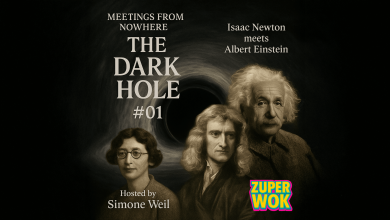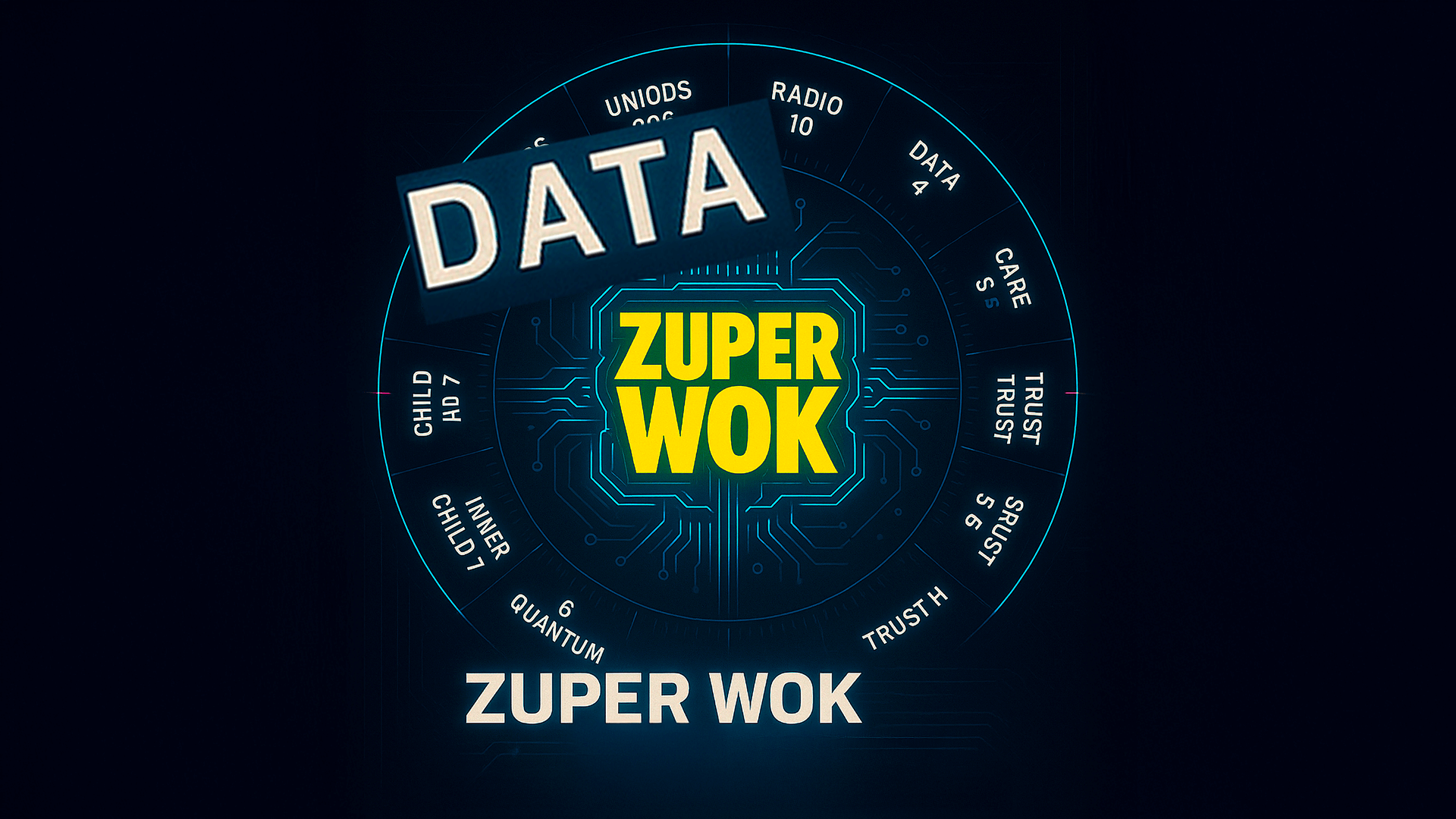
After ten hours of live radio, eight episodes and a season finale, around 90,000 spoken words, I asked an AI to treat ZUPER WOK like a dataset.
Not as poetry.
Not as therapy.
But as raw text to cut open and analyse: word frequencies, pronouns, emotional polarity, recurring themes.
The result is simple — and measurable.
This so-called “journey through the dark hole” is statistically dominated by love, care, breath and fluidity.
The darkness exists. But it never wins.
1. Size of the Beast
Let’s start with scale.
- Total corpus (after basic cleaning): ≈ 92,000 words
- Unique words: ≈ 7,500–8,000
- Average per episode: ≈ 9,500 words
- Final broadcast: ≈ 12,000–13,000 words (the densest)
This is not a podcast mini-series.
This is the equivalent of a full written season, spoken live.
2. Language Reality Check
Raw Top Words (all languages mixed, stopwords included)
Top recurring tokens confirm the oral, relational nature of the show:
- I: ≈ 2,400 occurrences
- you: ≈ 2,300
- we: ≈ 950
- now: ≈ 420
- radio: ≈ 190
- Berlin: ≈ 65
This is direct address radio.
Not narration. Not commentary. Conversation.
3. The Core Concepts (After Cleaning)
After removing English and French stopwords, the most frequent content words across the whole season are:
- love: ≈ 280
- body: ≈ 155
- breath / breathe / breathing: ≈ 190 combined
- world: ≈ 200
- radio: ≈ 185
- time / now: ≈ 380 combined
- dream / dreams: ≈ 110
- fluid / fluidity: ≈ 115
- modern / modernity: ≈ 105
Signature equation, statistically:
ZUPER WOK = love + breath + body + radio + world
4. Who Is Speaking to Whom?
Pronoun Distribution (Personal Space)
Across the entire corpus:
- I: ≈ 42%
- you: ≈ 40–41%
- we: ≈ 17–18%
This is crucial.
ZUPER WOK is not a collective sermon.
It is a me ↔ you system trying to slowly, carefully, construct a we.
The finale reinforces this pattern rather than flattening it.
5. Emotional Climate: Numbers Don’t Lie
Using two lexicons (positive / negative vocabulary):
Overall Polarity
- Positive words: ≈ 1,850 → ~2.0%
- Negative words: ≈ 500 → ~0.5%
➡ ~4 times more positive than negative vocabulary
Negative terms (dark, hole, fear, jealousy, addiction, war, grief) are present — but never dominant.
This is not denial.
It’s statistical resilience.

6. Episode by Episode: Where the Light Peaks
Highest Positive Density
- FIND PEACE, KNOW LOVE
≈ 3.8–4.0% positive words
≈ 0.3–0.4% negative
Highest Tension
- STRETCH AND DECENTRALIZE
≈ 1.6–1.8% positive
≈ 0.7% negative
The Final Broadcast
- Positive density ≈ 2.3–2.6%
- Negative density ≈ 0.6%
The finale is not the darkest.
It is the most saturated: every theme appears, compressed.
7. Major Quantified Themes
Love & Relationship
- love: ≈ 280 occurrences
- ≈ 45% concentrated in two episodes (love + finale)
Love is not a vibe.
It is a structural keyword.
Body & Breath
- body: ≈ 155
- breath / breathing: ≈ 190
➡ ~345 explicit somatic references
ZUPER WOK is statistically more body-centric than mind-centric.
Children & Inner Child
- child / children: ≈ 105 occurrences
- Peak concentration: CHILD IN CHILD OUT
Children are not metaphors here.
They are operators.
8. Modernity vs Fluidity: The Axis
Across the corpus:
- modern / modernity: ≈ 105
- fluid / fluidity: ≈ 115
They appear in balance, but not symmetrically:
- modernity is mostly framed as problem
- fluidity as response / adaptation
The finale makes this explicit in long thesis segments.
9. Dark, Dream, and the Inner Landscape
- dark: ≈ 60
- hole: ≈ 35
- “dark hole” (bigram): ≈ 22
- dream / dreams: ≈ 110
Dream vocabulary outnumbers dark vocabulary.
Darkness exists —
but dreams statistically dominate.
10. Place Matters: World, Radio, Berlin
- world: ≈ 200
- radio: ≈ 185
- Berlin: ≈ 65
Berlin appears in every episode.
This is situated radio, not abstract content.
11. Figures, Ghosts, Companions
Most cited figures (approx.):
- Emily: ≈ 55
- Nietzsche: ≈ 15
- Einstein: ≈ 15
- Newton: ≈ 18
- Freud: ≈ 10
- Deleuze / Stiegler / Rosa: ≈ 5–8 each
Philosophers are present but marginal.
They frame — they don’t dominate.
12. Language Signatures
High-frequency expressions:
- “super fresh” ≈ 100
- “Cashmere Radio” ≈ 60
- “you are not alone” / variants ≈ 45
- “end of the loop” / loop ≈ 70
- “now” ≈ 420
This is mantra logic, not branding logic.
Ultra-Short Conclusion (With Numbers)
Seen through its own statistics, ZUPER WOK is:
- ~92,000 words of live radio
- ~4× more positive than negative language
- ~340+ body & breath references
- A 42% “I” / 41% “you” dialogue
- A fragile but real 17% “we”
- A documented shift from modernity (≈105) to fluidity (≈115)