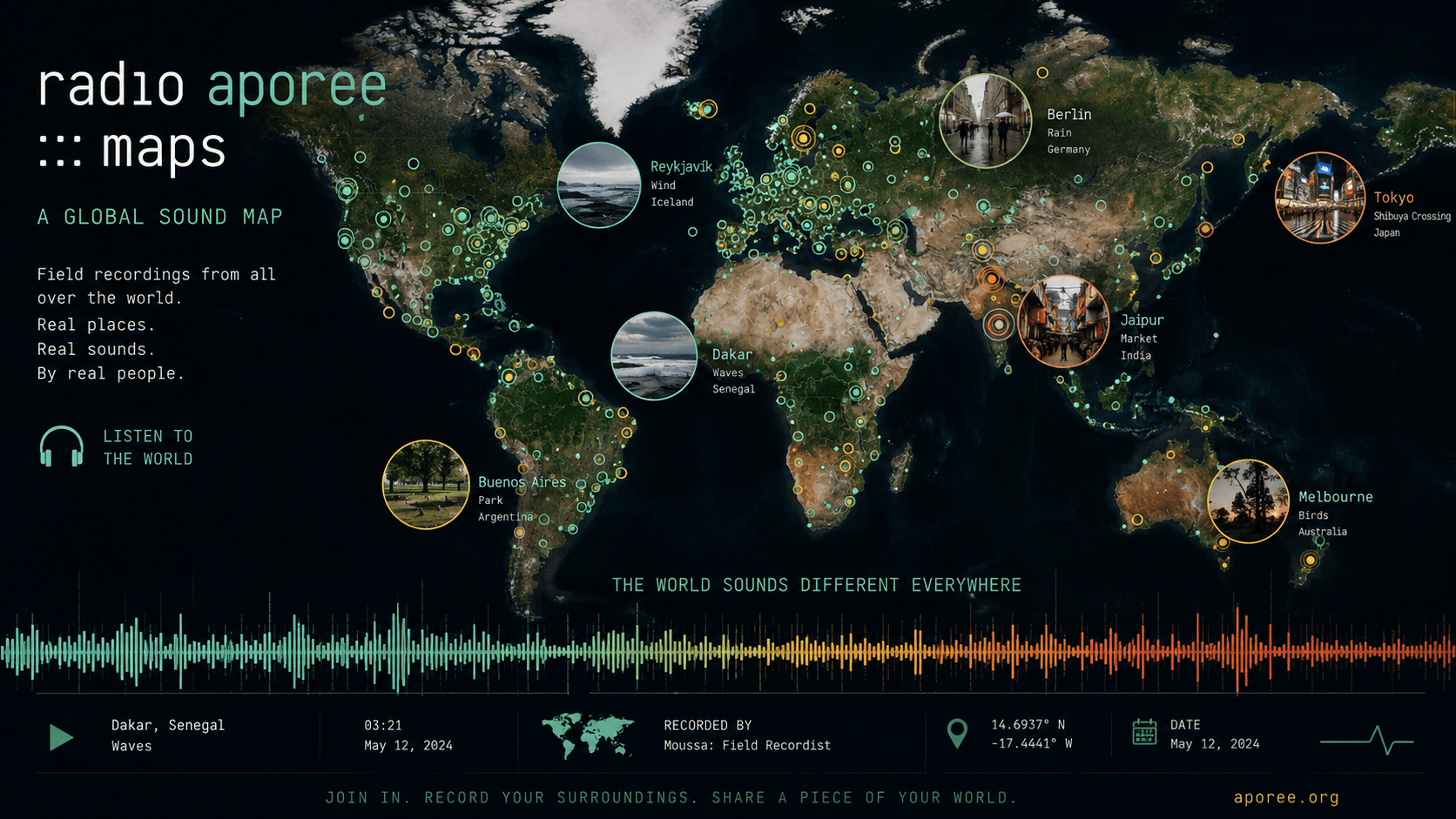
A street in Berlin at six in the morning. Birds in a forest in Finland. A market in Morocco. Rain falling somewhere in Japan. A railway station, a demonstration, insects, church bells, machines, conversations, wind, traffic, footsteps, waves. Thousands of places around the world have been recorded, positioned on a map and preserved exactly where they were heard. Open radio aporee and the planet becomes something we almost never see on the Internet: a map designed for our ears.
radio aporee is a collaborative global sound archive created by Berlin/Cologne-based artist and media technologist Udo Noll. Its central project, radio aporee ::: maps, has been developing since 2006 as a continuously expanding cartography of field recordings contributed by artists, phonographers, institutions and ordinary listeners around the world.
After Google Maps taught us to look at almost every corner of the planet, radio aporee asks a wonderfully simple question:
What if we could listen to it?
GOOGLE MAPS FOR YOUR EARS
The basic experience is immediately understandable. Open the soundmap, move around the world, zoom into a country, a city, a neighbourhood or a particular street and recordings begin to appear. Each point is attached to a real location. Click and listen.
You might hear birds, traffic, voices, construction work, bells, water, public transport, an empty building, a market, a political gathering or something whose significance only becomes apparent after several seconds of concentrated listening. These are primarily field recordings rather than polished pieces of music. Their subject is the acoustic reality of a place.
Google Maps tells us what somewhere looks like. Street View lets us virtually stand there.
radio aporee tells us what being there sounds like.
THE WORLD HAS AN ACOUSTIC GEOGRAPHY
We have become extraordinarily accustomed to thinking about geography visually. Maps describe territory using roads, buildings, rivers, borders, satellite photography and topography. Yet every place also possesses an acoustic identity.
Cities have rhythms. Buildings resonate differently. Languages occupy public space. Different vehicles create different backgrounds. Birds and insects indicate ecosystems. Church bells, calls to prayer, demonstrations, schoolyards, industrial machinery and public transport reveal how societies organise themselves. Sound contains information that an image cannot provide.
Close your eyes in Berlin, Naples, Tokyo, Dakar or New York and you can still feel that you are somewhere.
radio aporee maps this invisible layer.
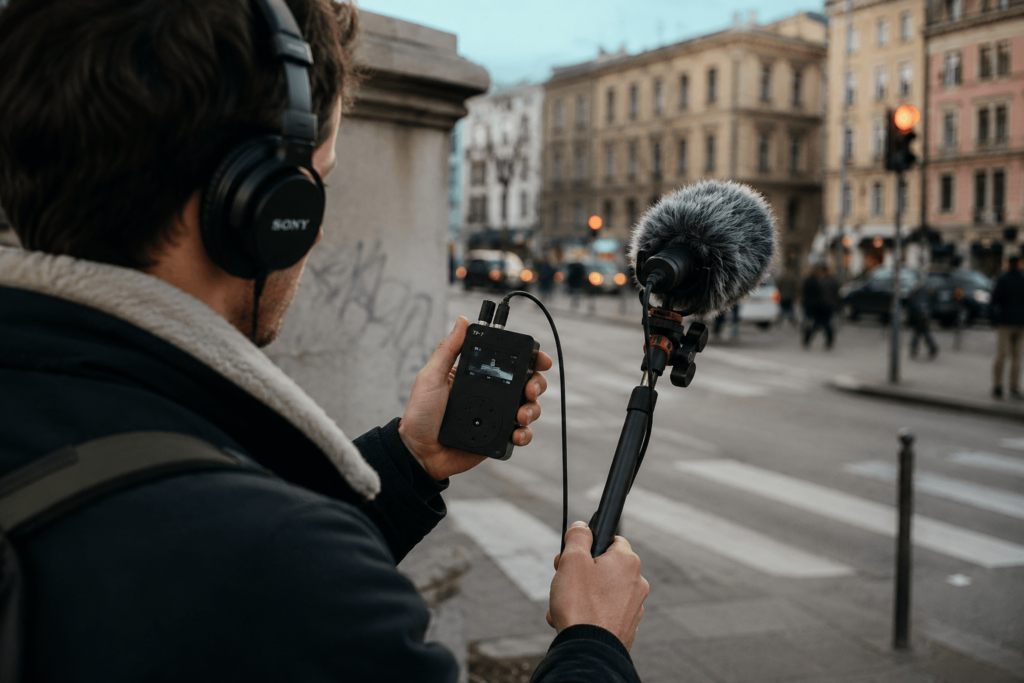
A SOUND MAP BUILT SINCE 2006
Udo Noll began radio aporee ::: maps in 2006 following earlier artistic research into mapping, navigation and the relationship between physical and virtual space. The project emerged at a moment when visual online geography was becoming increasingly powerful and ubiquitous. Noll approached the same transformation from another direction: connecting sound and space and opening the resulting cartography to public contribution.
Over the years, a large international community of artists, field recordists and contributors has populated the archive with recordings from natural, rural and urban environments, as well as public and private spaces. The collection has also become a resource for artistic practice and research around sound, place and listening.
The result feels less like a conventional media archive than an alternative representation of Earth.
A planet made from moments of listening.
THE RECORDINGS ARE ATTACHED TO PLACES
This is what makes radio aporee fundamentally different from simply browsing thousands of audio files. The location matters.
A recording of rain called rain_004.mp3 sitting inside a database is an audio file. Place that same recording on the exact location where somebody stood while recording it, add a date, a time and a description, and it becomes something else. It becomes a document.
You can listen to a neighbourhood before visiting it. You can compare different parts of a city. You can hear how people recorded the same place at different moments. You can encounter a location through the ears of somebody who decided that a particular sound deserved to be preserved.
Geography transforms sound into memory.
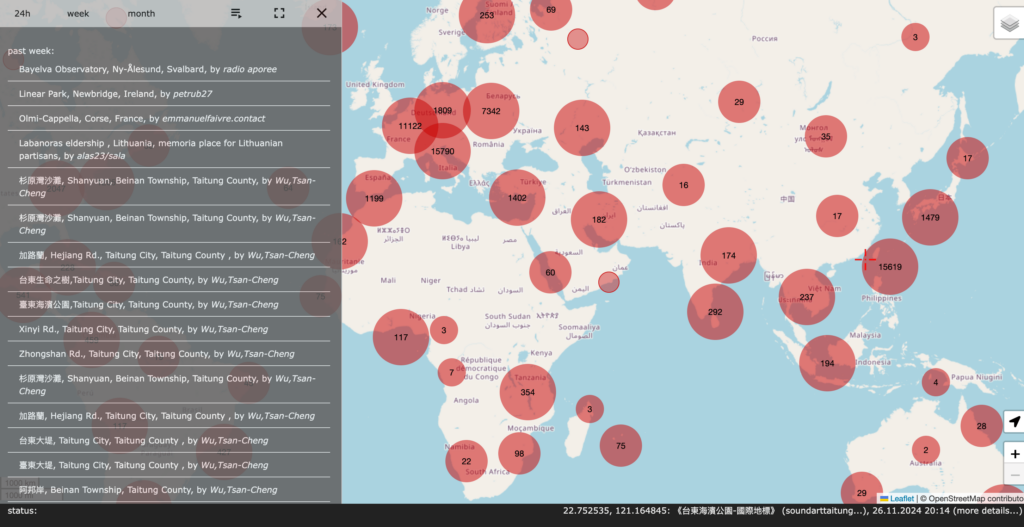
THE MAP IS ALSO AN ARCHIVE OF TIME
This temporal dimension becomes increasingly fascinating as the project gets older. radio aporee has existed for two decades, which means a recording uploaded in 2007 describes a place that may sound completely different today. Buildings disappear, roads change, businesses close, cars become quieter, construction sites become apartments, political demonstrations happen and disappear, animal populations change, people move away and languages migrate through neighbourhoods.
Sound is exceptionally good at recording these transformations because it captures enormous amounts of incidental information. The person holding the microphone may have been interested in a church bell while accidentally preserving the sound of the cars, voices, shops and street activity surrounding it. Years later, those background details can become the most interesting part of the recording.
radio aporee therefore gradually becomes something larger than a sound map.
It becomes an acoustic memory of the world.
ANYONE CAN HELP RECORD THE PLANET
This is perhaps the most important aspect of the project: radio aporee is collaborative.
The map grows because people record places and contribute those recordings. You do not need to document the Amazon rainforest or travel to an extraordinary location. Your street is already a location. The bakery downstairs is a location. The sound from your window at midnight is a location. A playground, metro station, market, park, football match, demonstration, forest, harbour, factory or café can become part of the archive.
The extraordinary thing about a global sound map is that ordinary sounds become valuable precisely because somebody bothered to preserve them.
RECORD YOUR STREET BEFORE IT CHANGES
There is something worth understanding about field recording: the present always feels ordinary while we are living inside it.
The sound of your street today may seem completely unremarkable. Record it. Twenty years from now, it may be impossible to reproduce. The engines will have changed. The shops may have disappeared. Different languages may be spoken outside. The building opposite may have been demolished. The café may have become a bank and then an apartment. A tram line may have appeared. The birds may have changed.
An audio recording captures all of this without necessarily trying. Photography taught generations of people to document what the world looks like. Projects such as radio aporee suggest that we should also document what the world sounds like.
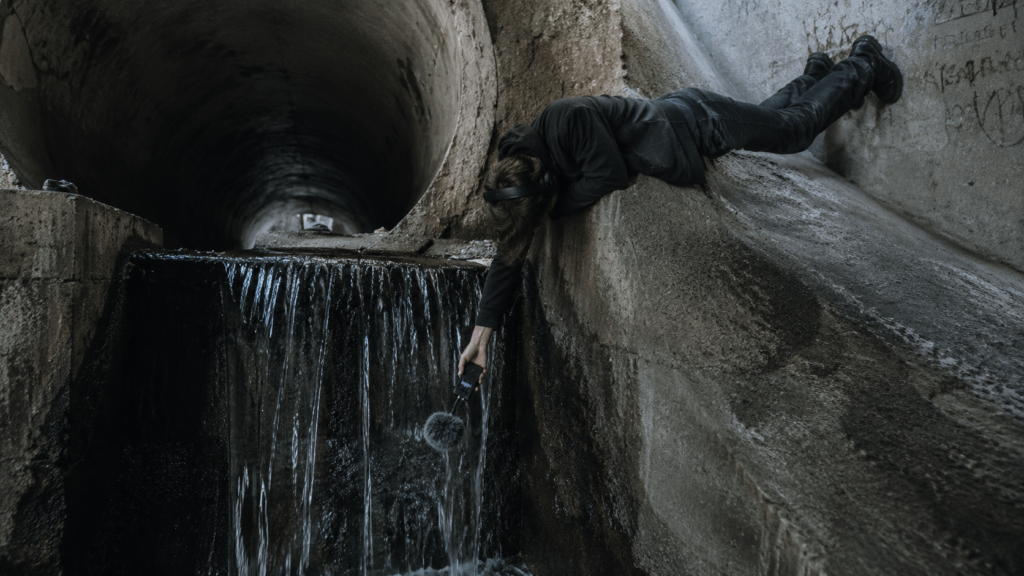
YOUR PHONE IS ALREADY A FIELD RECORDER
The barrier to participation has changed dramatically since radio aporee began. In 2006, high-quality field recording usually implied dedicated equipment. Today almost everybody carries a reasonably capable recording device in their pocket.
A smartphone is enough to begin.
Better microphones and dedicated field recorders can obviously produce richer recordings, but the cultural value of a recording comes from more than technical perfection. Place, timing, context and attention matter enormously.
The essential act is listening. Stop somewhere, remain quiet, record and listen again. Suddenly a location you crossed every day without thinking becomes incredibly dense.
That may be one of radio aporee’s greatest achievements: the platform encourages us to pay attention before it encourages us to upload anything.
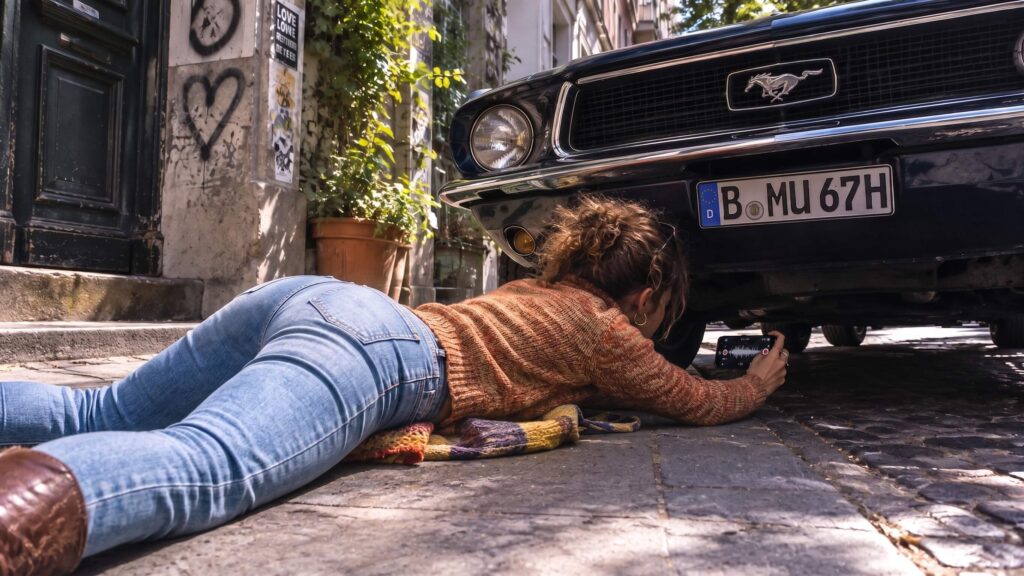
FROM LISTENER TO CONTRIBUTOR
The traditional relationship with media separates production from consumption. Somebody broadcasts and everybody else listens. radio aporee makes this boundary porous. Its philosophy extends beyond the soundmap into experiments around radio, mobile media, public space and participation.
You listen to somebody else’s street. Then you record yours. The listener becomes the recorder, the receiver becomes the transmitter and the archive grows.
This simple circulation fundamentally changes the nature of the project because radio aporee becomes a representation of the world produced by thousands of individual acts of attention.
A RADIO STATION MADE FROM THE EARTH
The project goes even further because the soundmap also feeds a continuous 24-hour Internet radio stream. radio aporee continuously plays recordings drawn from its global archive, with a stream capable of reacting to activity around the platform, including new uploads, listeners, mobile activity, live sessions and other events.
The idea is beautiful. Instead of a DJ selecting songs from a music library, geography becomes part of the programming system.
The Earth becomes the playlist.
WALKING THROUGH AUGMENTED SOUND
Another branch of the project, miniatures for mobiles, pushes the relationship between sound and geography even further. Artists can create location-based sound works intended to be experienced while physically walking through a particular area. Sounds change according to the listener’s position and movement, mixing with the actual acoustic environment surrounding them.
It is essentially augmented reality built for ears rather than eyes. Instead of pointing a camera at a street and placing a virtual object over the image, a listener walks through physical space while another acoustic layer emerges around it.
The city becomes the interface. Walking becomes playback.
ANOTHER KIND OF INTERNET
radio aporee also belongs to a particular lineage of Internet projects that feels increasingly important. They use technology to reveal complexity rather than remove it.
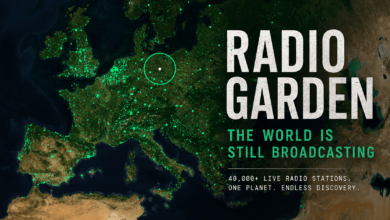
Every Noise at Once lets us navigate the relationships between thousands of musical genres. Radio Garden lets us navigate tens of thousands of radio stations through geography. radio aporee lets us navigate the sound of the world itself.
Every Noise maps music. Radio Garden maps broadcasters. radio aporee maps the audible world.
All three turn databases into territories. This is fundamentally different from the dominant logic of the contemporary feed. A feed attempts to predict what should interest us next. A map exposes possibilities and allows curiosity to determine the journey.
You can arrive on radio aporee looking for Berlin and end up listening to a field recording made thousands of kilometres away because a point on the map attracted your attention.
Nobody needed to recommend it. You found it.
WE HAVE PHOTOGRAPHED ALMOST EVERYTHING
Humanity has created an extraordinary visual archive of itself. Billions of photographs are produced every day. Satellites continuously photograph Earth. Street View vehicles systematically document roads. Security cameras record cities. Social networks accumulate endless images of meals, faces, buildings, holidays and sunsets.
Our acoustic archive remains comparatively invisible.
Yet sound is one of the strongest mechanisms of memory we possess. A voice can resurrect a person. A station announcement can resurrect a journey. A particular street noise can return us to a city. A bird heard through an open window can suddenly reconstruct an entire summer.
radio aporee treats these sounds as something worth preserving.
PUT YOUR PLACE ON THE MAP
That makes the project more than an interesting website to browse. It is an invitation to participate.
Go outside with a recorder or your phone. Find somewhere that means something to you, or somewhere completely ordinary. Listen for a few minutes before recording. Capture enough time for the place to reveal itself. Add context. Locate it accurately. Contribute it to the map.
Someone might listen tomorrow. Someone might discover it from another continent. Someone might hear it twenty years from now after the place itself has completely changed.
The Internet has spent decades building an image of the world.
radio aporee is helping us remember what it sounded like.