« `html
DU POINT DE VUE DE LA SEMELLE
Trois ans dans les rues, quelques saisons, beaucoup de kilomètres et une caméra installée au plus près de la chaussure : pour raconter le cycle de vie d’une paire de VEJA V-90, nous avons choisi de regarder le monde depuis ses pieds.
UNE CAMÉRA DANS LA V-90
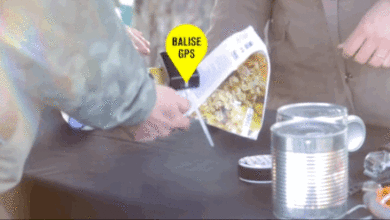
Le film suit la chaussure à hauteur de semelle. Pour obtenir ce point de vue, nous avons fabriqué un système permettant de filmer en POV directement depuis la V-90. La caméra accompagne ainsi la chaussure dans son environnement, ses mouvements et son voyage jusqu’au recyclage.
TROIS ANS AUX PIEDS
Il y a trois ans, j’ai acheté une paire de V-90 blanches dans la boutique VEJA de Berlin. Leur semelle contient notamment du caoutchouc sauvage provenant d’Amazonie. Depuis, elles m’accompagnent toute l’année, de l’été à l’hiver, du printemps à l’automne.
Je les porte, je les entretiens, je les nettoie et, lorsque certaines traces résistent, je les confie à un nettoyage professionnel. La durée de vie d’une sneaker commence aussi par ce geste très simple : continuer à la porter.
Lorsqu’elles seront réellement usées, l’étape suivante sera la réparation. Puis, lorsque leur vie de chaussure arrivera finalement à son terme, elles pourront rejoindre une borne de collecte VEJA et commencer une autre histoire.
DE BERLIN À BOURG-EN-BRESSE
La paire quitte alors le pied pour entrer dans une chaîne industrielle. Les sneakers collectées sont acheminées vers Bourg-en-Bresse, chez EIGHT IMPACT, une installation capable de traiter le recyclage des chaussures à l’échelle industrielle.
Une sneaker constitue un objet particulièrement dense : textiles, mousses, caoutchouc, colles et éléments métalliques sont assemblés pour résister ensemble pendant des années. Le recyclage commence donc par une opération mécanique essentielle : remettre tous ces matériaux en mouvement afin de pouvoir les séparer.
40 MILLIMÈTRES
Un premier granulateur broie les chaussures en morceaux d’environ 40 millimètres. Cette fragmentation libère progressivement les différents composants et rend leur séparation possible.
Des aimants extraient d’abord les parties métalliques. Un séparateur à sec retire ensuite progressivement les fibres textiles. Le mélange restant, principalement constitué de caoutchouc et de mousse, passe par un second broyage jusqu’à atteindre des fragments d’environ cinq à six millimètres.
Un système de séparation par flux d’air affine encore la matière. Les composants plus légers sont dissociés du caoutchouc, qui atteint après purification une pureté supérieure à 99 %.
MOINS D’UN MILLIMÈTRE
Le caoutchouc purifié entre ensuite dans un microniseur, un moulin industriel capable de réduire les fragments en une poudre extrêmement fine de moins d’un millimètre.
Cette poudre constitue la matière la plus précieuse du processus. Elle peut être réintroduite dans un nouveau mélange de caoutchouc naturel et retrouver une fonction mécanique dans une nouvelle semelle.
LA V-82
Cette matière recyclée entre dans la fabrication des semelles de la V-82. Leur composition associe 40 % de caoutchouc sauvage récolté en Amazonie et 10 % de poudre de caoutchouc issue de ce processus de recyclage.
Le geste boucle ainsi une partie du cycle : une matière qui a déjà parcouru des milliers de kilomètres sous une paire de chaussures peut revenir dans une nouvelle semelle. Le caoutchouc conserve une valeur matérielle après la fin du premier produit et rejoint une nouvelle génération de sneakers.
POURQUOI LE POV ?
Nous voulions raconter ce processus depuis l’objet lui-même. La V-90 devenait donc à la fois le sujet du film, son moyen de transport et son point de vue. Nous avons développé un système de prise de vue permettant d’installer la caméra au niveau de la chaussure afin de suivre son mouvement avec une perspective habituellement invisible.
Le format vertical accentue cette sensation. Le sol défile, le corps reste partiellement hors champ et la chaussure devient le personnage principal. Ce dispositif transforme une histoire industrielle — collecte, broyage, séparation, micronisation et réincorporation — en voyage physique.
Au bout de ce voyage, la caméra retrouve presque son point de départ : une semelle. Une autre chaussure. Une matière qui continue de circuler.
FROM THE SOLE’S POINT OF VIEW
Three years on the streets, four seasons, countless kilometres and a camera mounted as close to the sneaker as possible: to tell the life cycle of a pair of VEJA V-90s, we decided to see the world from their point of view.
A CAMERA IN THE V-90
The film follows the sneaker at sole level. To create this perspective, we built a system that allowed us to shoot POV directly from the V-90. The camera travels with the sneaker through its environment, its movements and eventually its journey into recycling.
THREE YEARS ON MY FEET
Three years ago, I bought myself a pair of white V-90s at the VEJA store in Berlin. Their soles contain wild rubber sourced from the Amazon rainforest. I have been wearing them ever since, through summer, autumn, winter and spring.
I wear them, take care of them and clean them. When stains become too stubborn, I have them professionally cleaned. Extending the life of a sneaker begins with an extremely simple gesture: continuing to wear it.
When they eventually become too worn, repair will come next. And when their life as shoes finally reaches its end, they can enter a VEJA collection bin and begin another journey.
BERLIN TO BOURG-EN-BRESSE
The pair leaves the foot and enters an industrial process. Collected sneakers travel to Bourg-en-Bresse, France, to EIGHT IMPACT, a facility designed to process sneaker recycling at industrial scale.
A sneaker is an unusually dense object. Textiles, foams, rubber, adhesives and metal components have been engineered to remain firmly connected for years. Recycling therefore begins by mechanically breaking this structure apart so its materials can move independently again.
40 MILLIMETRES
A primary granulator first shreds the sneakers into pieces measuring roughly 40 millimetres. Fragmentation gradually releases the different components and makes their separation possible.
Magnets extract the metallic components. A dry separation process then removes textile fibres. The remaining rubber and foam are ground once again, this time into fragments measuring only five to six millimetres.
An airflow separator refines the mixture further, isolating the rubber from lighter materials. After purification, the recovered rubber reaches a purity of more than 99%.
LESS THAN ONE MILLIMETRE
The purified rubber then enters a microniser, a powerful industrial mill that transforms the fragments into an extremely fine powder measuring less than one millimetre.
This powder is the valuable outcome of the process. It can be blended back into natural rubber and regain a mechanical function inside a new sole.
THE V-82
This recovered material is used in the soles of the V-82. Their composition combines 40% wild rubber tapped in the Amazon rainforest with 10% recycled rubber powder produced through this recycling process.
The gesture closes part of the loop: material that has already travelled thousands of kilometres beneath a pair of shoes can return inside a new sole. The rubber retains material value beyond the life of its first product and enters a new generation of sneakers.
WHY POV?
We wanted to tell this process from the object itself. The V-90 therefore became the subject of the film, its vehicle and its point of view. We developed a camera system that could sit at sneaker level and follow its movement from a perspective that usually remains invisible.
The vertical format reinforces that sensation. The ground rushes past, the body remains partly outside the frame and the sneaker becomes the main character. The device turns an industrial story — collection, shredding, separation, micronisation and reincorporation — into a physical journey.
At the end of that journey, the camera almost returns to where it started: a sole. Another sneaker. Material continuing to move.
« `