Une radio qui voyage à votre place.
WAVE ROAM MINI transforme la radio mondiale en moyen de transport. Tu appuies sur PLAY à Linz. Ensuite, la machine part seule.

La radio comme moyen de transport
WAVE ROAM MINI est une boîte qui fait voyager à travers le monde par la radio.
Le principe tient presque en un bouton : PLAY. Le voyage commence toujours au même endroit : Linz, en Autriche, avec Radio FRO. Puis la machine prend le contrôle. Elle cherche un autre signal, prépare la radio suivante pendant que la première joue, change de ville, de pays, de langue, de musique, de voix et recommence.
Il n’y a pas de destination. Il n’y a pas de playlist. Il n’y a plus vraiment de programme au sens classique.
La radio devient un véhicule.

SCAN → TRAVEL → LISTEN → REPEAT
WAVE ROAM explore surtout les marges du spectre : radios indépendantes et communautaires, free radio, sound art, field recordings, ambient, noise, electroacoustic, freeform, cultures locales et autres signaux que l’on rencontre rarement en cherchant simplement « une radio ».
Chaque voyage commence à Linz, mais la suite change à chaque fois. Tunis peut conduire à Mexico, Mexico à Séoul, Séoul à Bogotá, puis à une petite radio dont je ne connaissais même pas l’existence cinq minutes auparavant.
Pendant qu’une station joue, la machine cherche et vérifie déjà la suivante. Le passage d’un territoire à l’autre doit ressembler davantage à un déplacement qu’à une recherche dans un catalogue.
APRÈS RADIO GARDEN : LAISSER LA RADIO CONDUIRE
Quelques semaines avant de construire WAVE ROAM MINI, j’écrivais un article sur Radio Garden: Where the World’s Web Radios Finally Have a Place. Radio Garden m’intéresse parce qu’il a réussi quelque chose d’essentiel : transformer les milliers de radios dispersées sur Internet en un territoire que l’on peut parcourir.
Avec Radio Garden, on fait tourner la planète jusqu’à tomber sur un signal. La curiosité est le moteur. On choisit la direction.
WAVE ROAM MINI inverse le geste.
Tu ne voyages pas vers la radio. La radio te fait voyager.
On appuie sur PLAY. Le voyage commence à Radio FRO, à Linz. Puis la machine prend la main. Une station devient un lieu, le lieu devient une étape, et l’étape appelle la suivante.
Mais la sélection n’est pas complètement aléatoire. Pour cette première version, les radios sont choisies dans l’esprit de Franz Xaver et de sa pratique de la radio : free radios, radios communautaires et expérimentales, sound art, transmission, interférences, électronique, field recordings, scènes underground, voix locales et signaux situés aux marges des grands réseaux médiatiques.
Il ne s’agit pas de fabriquer un Spotify mondial de la radio. La machine cherche plutôt les endroits où la radio reste un médium vivant, étrange, local, libre et imprévisible.
On peut intervenir avec NEXT, mais on peut aussi laisser la machine fonctionner pendant une heure, un après-midi ou toute une nuit. Le voyage n’a volontairement aucune durée prédéfinie.
Radio Garden a rendu visible la planète radio. WAVE ROAM MINI lui demande maintenant de nous emmener quelque part.

Écouter un lieu
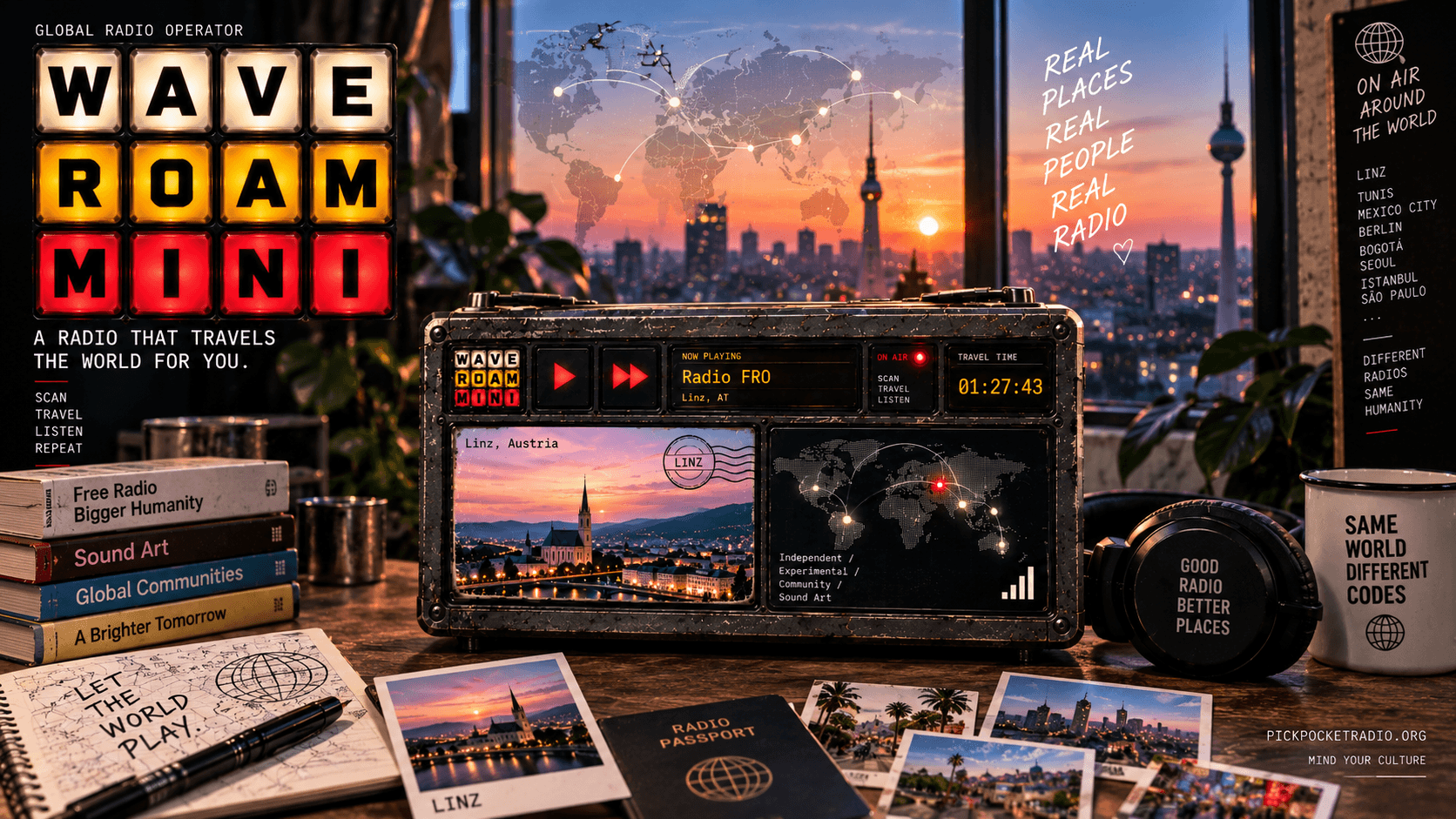
À chaque déplacement, l’écran change avec le signal : station réellement en train de jouer, ville, pays, informations sur son univers, lien direct vers son stream et position sur la carte.
Je voulais ajouter autre chose : une carte postale. Pas nécessairement le monument le plus célèbre de la ville, mais des images capables de montrer un peu du tissu social derrière le signal — rues, quartiers, places, marchés, architecture, vie quotidienne.
Une machine avec une mémoire
WAVE ROAM essaie de ne pas tourner en rond. Une station déjà entendue ne doit normalement pas revenir avant qu’au moins 100 autres radios aient été traversées.
Chaque nouveau voyage reconstruit son chemin. Linz reste le point zéro. Après quatre découvertes, Pick Pocket Radio apparaît une seule fois en sixième position, comme une station parmi les autres. Puis la machine repart.
NEXT n’est pas une playlist
Pendant qu’une radio joue, WAVE ROAM prépare déjà le prochain signal. Le nom de la station suivante apparaît dans l’écran NEXT RADIO.
Si je ne touche à rien, la machine finit par partir seule. Si j’appuie sur NEXT, je provoque immédiatement le déplacement.
PRINT : garder la trace
La radio est magnifique aussi parce qu’elle disparaît. On entend quelque chose. Ça passe. C’est terminé.
Le bouton PRINT inverse momentanément cette logique. Il produit la trace du déplacement : radios entendues, villes traversées, temps d’écoute, liens directs vers les streams, cartes postales et carte finale du parcours.
Ce n’est pas une playlist. C’est presque un carnet de voyage généré par les ondes.

De Franz Xaver à WAVE ROAM
La machine est née à la suite d’une invitation de Shu Lea Cheang pour Radiotopias: sound off wave on, autour de Franz Xaver à Linz.
Son travail autour de la free radio, des antennes, de la transmission, des champs électromagnétiques, des interférences et de l’inconnu m’a donné une direction : considérer la radio non seulement comme un média qui diffuse du contenu, mais comme un espace dans lequel on peut se déplacer.
WAVE ROAM MINI commence donc symboliquement et littéralement à Linz.
Puis Linz disparaît. Le monde entre.
Une application, mais surtout un objet
J’ai volontairement dessiné WAVE ROAM MINI comme une machine physique qui n’existe pas encore : métal rayé, vis, écrans noirs, voyants, gros boutons lumineux.
PLAY. NEXT. STOP. PRINT.
Le logiciel existe aujourd’hui comme application web, comme version de bureau et dans une version compacte pensée pour Rabbit.
WAVE ROAM MINI
A box that makes you travel through the world by radio.
PRESS PLAY. THE WORLD COMES IN.
SCAN → TRAVEL → LISTEN → REPEAT.
The journey is the work.
A radio that travels for you.
WAVE ROAM MINI turns global radio into a means of transportation. Press PLAY in Linz. From there, the machine leaves by itself.
Radio as transportation
WAVE ROAM MINI is a box that makes you travel through the world by radio.
The principle is almost reduced to one button: PLAY. Every journey starts in Linz, Austria, with Radio FRO. Then the machine takes over. It searches for another signal, prepares the next station while the current one is still playing, changes city, country, language, music and voices, and keeps moving.
There is no destination, no fixed playlist and no predetermined route.
Radio becomes a vehicle.
SCAN → TRAVEL → LISTEN → REPEAT
WAVE ROAM explores the edges of the global radio spectrum: independent and community stations, free radio, sound art, field recordings, ambient, noise, electroacoustic, freeform, local cultures and other signals that are hard to encounter by simply searching for “a radio”.
Every trip begins in Linz, but what follows changes each time. Tunis can lead to Mexico City, Mexico City to Seoul, Seoul to Bogotá, then to a tiny station I did not know existed five minutes earlier.
While one station is playing, the machine is already finding and checking the next one. Moving between territories should feel more like travel than browsing a catalogue.
AFTER RADIO GARDEN: LET THE RADIO DRIVE
A few weeks before building WAVE ROAM MINI, I wrote an article about Radio Garden: Where the World’s Web Radios Finally Have a Place. What fascinated me about Radio Garden was its ability to turn thousands of scattered internet radio stations into a territory that could actually be explored.
With Radio Garden, you rotate the planet until you encounter a signal. Curiosity is the engine. You choose the direction.
WAVE ROAM MINI reverses the gesture.
You don’t travel to the radio. The radio makes you travel.
Press PLAY. The journey begins with Radio FRO in Linz. Then the machine takes over. A station becomes a place, the place becomes a stop, and each stop leads to another.
But the selection is not entirely random. For this first version, the radios are selected in the spirit of Franz Xaver and his approach to radio: free and community radio, experimental broadcasting, sound art, transmission, interference, electronics, field recordings, underground scenes, local voices and signals operating at the edges of mainstream media.
The aim is not to build a global Spotify for radio. The machine searches instead for places where radio remains a living, strange, local, free and unpredictable medium.
You can intervene with NEXT, or simply let the machine keep moving for an hour, an afternoon or all night. The journey deliberately has no fixed duration.
Radio Garden made the radio planet visible. WAVE ROAM MINI now asks it to take us somewhere.
Listening to a place
With every jump, the screen changes with the signal: the station actually playing, city, country, context, direct stream link and position on the world map.
I wanted to add something else: a postcard. Not necessarily the most famous landmark, but images that reveal some of the social fabric behind the signal — streets, neighborhoods, squares, markets, architecture and everyday life.
A machine with memory
WAVE ROAM tries not to go in circles. A station that has already been heard should normally not return until at least 100 other stations have been crossed.
Every new journey rebuilds its path. Linz remains point zero. After four discoveries, Pick Pocket Radio appears once, in sixth position, as one station among the others. Then the machine keeps going.
NEXT is not a playlist
While a station is playing, WAVE ROAM is already preparing the next signal. The upcoming station appears on the NEXT RADIO display.
If I do nothing, the machine eventually leaves by itself. If I press NEXT, I trigger the move immediately.
PRINT the journey
Radio is also beautiful because it disappears. You hear something. It passes. It is gone.
PRINT temporarily reverses that logic. It keeps a trace of the trip: stations, cities, listening times, direct stream links, postcards and a final route map.
It is not a playlist. It is closer to a travel diary generated by radio waves.
From Franz Xaver to WAVE ROAM
The machine emerged after an invitation from Shu Lea Cheang for Radiotopias: sound off wave on, around Franz Xaver in Linz.
His work around free radio, antennas, transmission, electromagnetic fields, interference and the unknown gave me a direction: to consider radio not only as a medium broadcasting content, but as a space one can move through.
WAVE ROAM MINI therefore begins, symbolically and literally, in Linz.
Then Linz disappears. The world comes in.
An app, but above all an object
I deliberately designed WAVE ROAM MINI as a physical machine that does not yet exist: scratched metal, screws, black displays, status lights and large illuminated buttons.
PLAY. NEXT. STOP. PRINT.
The software now exists as a web application, a desktop version and a compact version designed for Rabbit.
WAVE ROAM MINI
A box that makes you travel through the world by radio.
PRESS PLAY. THE WORLD COMES IN.
SCAN → TRAVEL → LISTEN → REPEAT.
The journey is the work.