Claude transforme Fermat en code : bienvenue dans l’intelligence fluide
En onze jours, une démonstration monumentale devient une architecture vérifiable par machine. Derrière la prouesse technique, une autre histoire apparaît : la fin du savoir solide et l’arrivée d’une intelligence distribuée.

En 1637, Pierre de Fermat écrit dans la marge d’un livre qu’il possède une démonstration merveilleuse, mais que la marge est trop petite pour la contenir. Presque quatre cents ans plus tard, la marge fait treize millions de lignes.
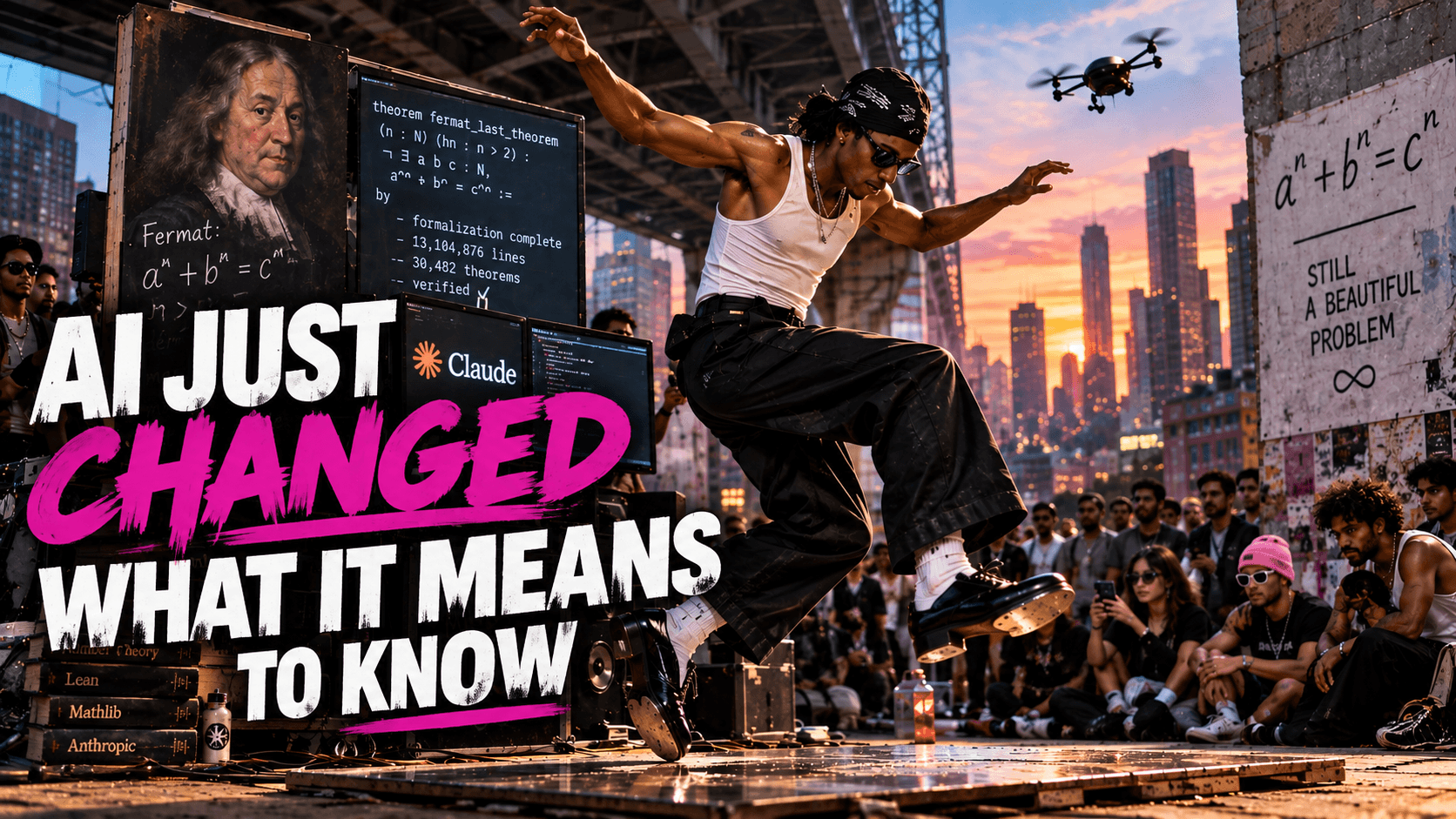
Pendant onze jours, Claude, l’intelligence artificielle d’Anthropic, a travaillé à la formalisation du dernier théorème de Fermat. Andrew Wiles avait résolu le problème dans les années 1990. Claude vient de faire passer cette immense construction mathématique dans un autre état : environ treize millions de lignes de Lean, plus de trente mille théorèmes intermédiaires et une architecture logique pouvant être parcourue et vérifiée automatiquement par une machine. Fermat avait une marge. Wiles avait du papier. Claude a un réseau de machines. C’est une très belle image de notre époque.
DE MATRIX À FERMAT
Dans Matrix, Neo passe une partie du film à apprendre les règles du monde. Puis quelque chose bascule. Il voit la matrice. Les murs, les objets et les corps deviennent du code. La réalité solide révèle l’architecture de relations qui la produit. À partir de cet instant, Neo peut circuler dans le système autrement. Claude vient de faire quelque chose d’assez proche avec une cathédrale des mathématiques. Une démonstration conçue par des humains devient un objet formel parcouru par une intelligence artificielle et vérifié par Lean. Le texte mathématique, les équations, le code, les bibliothèques de théorèmes, l’IA, les ordinateurs et les mathématiciens appartiennent au même processus. Le savoir change d’état.

L’INTELLIGENCE DEVIENT UN RÉSEAU
Nous représentons encore volontiers l’intelligence avec une tête. Einstein devant son tableau. Le professeur entouré de livres. Le savant capable de construire dans son cerveau une représentation du monde. Cette image raconte parfaitement la modernité : un sujet observe le monde, le découpe, le mesure, le classe et produit une représentation rationnelle de la réalité. Le dernier théorème de Fermat possède même tous les ingrédients de cette mythologie. Un homme pose un problème. Des générations de mathématiciens cherchent. Andrew Wiles travaille pendant des années et produit la démonstration. Le héros et le problème se font face. Claude fait apparaître une autre image. La connaissance circule entre Fermat, Wiles, Taylor, des générations de mathématiciens, des articles, des bibliothèques mathématiques, Mathlib, Lean, des agents Claude, des ordinateurs et les humains qui organisent l’ensemble. L’intelligence ressemble soudain beaucoup plus à Internet qu’à Einstein. Elle devient une architecture de connexions.

GUATTARI AVAIT DÉJÀ VU LA MACHINE ARRIVER
Dans Chaosmose, publié en 1992, Félix Guattari élargit déjà radicalement ce que nous appelons une machine. La machine industrielle possède des composantes matérielles et énergétiques, mais aussi des composantes diagrammatiques et algorithmiques : plans, formules, équations, calculs, programmes. Trente-quatre ans plus tard, Claude et Lean donnent une forme spectaculaire à cette intuition. La machine mathématique se compose de processeurs, de langage, de bibliothèques, d’algorithmes, de textes scientifiques, d’agents artificiels et de connaissances humaines accumulées pendant des siècles. La machine devient l’ensemble des relations. Bernard Stiegler pousse cette histoire du côté de l’humain. Dans Réenchanter le monde, il pense notre appareil psychique comme quelque chose qui se prolonge, se distribue et se délègue dans des appareils techniques. L’écriture constitue déjà une mémoire extérieure. Le livre organise la pensée au-delà du cerveau. La photographie conserve des images. L’enregistrement conserve des voix. L’ordinateur traite des informations. Internet relie des mémoires. L’intelligence artificielle ajoute aujourd’hui une nouvelle couche à cette longue histoire de l’externalisation de nos facultés. Avec Claude et Fermat, une partie du raisonnement rejoint à son tour cette circulation.

DE LEGO À MINECRAFT
La modernité aimait les objets. Les disciplines. Les catégories. Les institutions. Les frontières. Les structures suffisamment stables pour être mesurées, classées, administrées et reproduites. Le monde qui apparaît ressemble davantage à Minecraft. Dans LEGO, la construction repose sur des pièces déjà définies que l’on assemble. Dans Minecraft, le monde lui-même devient matière à transformation. On creuse, on combine, on construit, puis on découvre la redstone et l’environnement devient programmable. À un certain moment, le joueur agit autant sur les relations entre les éléments que sur les éléments eux-mêmes. C’est ce passage qui m’intéresse. Le XXe siècle l’a raconté de multiples façons : cybernétique, théorie des systèmes, écologie, réseaux, postmodernité. Zygmunt Bauman lui donnera une image particulièrement simple avec La Vie liquide : les conditions dans lesquelles nous agissons changent plus rapidement que les formes ont le temps de se solidifier. Un cerveau devient un réseau. Une ville devient un réseau. Une économie devient un réseau. Une culture devient un flux. Une identité devient relationnelle. Une démonstration mathématique devient une architecture distribuée entre humains et machines. La fluidité apparaît comme la forme naturelle de l’après-modernité.

L’INTELLIGENCE FLUIDE
J’appelle fluidité la capacité à circuler dans ces systèmes, à établir des connexions, à changer d’échelle, à écouter les informations produites par le milieu et à réorganiser sa trajectoire. L’intelligence fluide appartient alors à l’individu et aux relations qu’il sait construire. Je l’expérimente quotidiennement en écrivant. Autour de moi, des livres. Dans mon ordinateur, des milliers de notes. Sur Internet, une bibliothèque planétaire. Devant moi, plusieurs intelligences artificielles capables de chercher, comparer, confronter, tester une intuition et rapprocher deux idées séparées par trois siècles. Mon travail consiste de plus en plus à établir les connexions. C’est aussi pour cela que Hiro, le personnage de Snow Crash de Neal Stephenson, m’accompagne depuis le début de cette réflexion. Hiro dialogue avec la Librarian, une interface conversationnelle donnant accès à une immense mémoire documentaire. Il avance en posant des questions, en rapprochant des informations, en suivant des pistes et en faisant apparaître progressivement une structure. Publié en 1992, encore. La même année que Chaosmose.

FERMAT EST UNE NEWS SUR NOUS
La performance de Claude raconte évidemment quelque chose sur l’évolution de l’intelligence artificielle. Elle raconte surtout quelque chose sur la transformation de notre place dans les systèmes de connaissance. Après avoir externalisé la mémoire dans l’écriture, démultiplié sa circulation avec l’imprimerie, externalisé le calcul dans les machines et connecté nos connaissances avec Internet, nous entrons dans une époque où une partie du raisonnement et de la preuve circule également entre humains et machines. La modernité nous a appris à construire des structures solides pour comprendre et organiser le monde. La fluidité nous apprend à circuler dans un monde de relations. C’est précisément l’enquête que je poursuis dans MAISON FLUID, un livre sur la fin de la modernité observée depuis l’endroit le plus quotidien possible : une maison, un couple, deux enfants, un cerveau, des écrans, des plaisirs, des peurs, des habitudes et la tentative d’apprendre à vivre dans un monde qui a déjà changé de forme. Fermat avait écrit sa démonstration dans une marge. Quatre siècles plus tard, la marge est devenue le réseau.
DANS LA BIBLIOTHÈQUE DE MAISON FLUID
Félix Guattari — Chaosmose, Éditions Galilée, 1992. Neal Stephenson — Snow Crash, 1992. Bernard Stiegler — Réenchanter le monde. La valeur esprit contre le populisme industriel, Flammarion, 2006. Zygmunt Bauman — La Vie liquide, 2005. Anthropic — Formalizing Fermat’s Last Theorem, septembre 2026. Andrew Wiles / Richard Taylor — travaux ayant conduit à la démonstration du dernier théorème de Fermat, 1994-1995.
Claude Turns Fermat Into Code: Welcome to Fluid Intelligence
In eleven days, a monumental proof becomes a machine-checkable architecture. Behind the technical feat, another story appears: the end of solid knowledge and the rise of distributed intelligence.
In 1637, Pierre de Fermat wrote in the margin of a book that he had a truly marvelous proof, but that the margin was too small to contain it. Almost four hundred years later, the margin is thirteen million lines long.
For eleven days, Claude, Anthropic’s AI, worked on the formalization of Fermat’s Last Theorem. Andrew Wiles had solved the problem in the 1990s. Claude has now moved that immense mathematical construction into another state: roughly thirteen million lines of Lean, more than thirty thousand intermediate theorems, and a logical architecture that can be traversed and automatically checked by a machine. Fermat had a margin. Wiles had paper. Claude has a network of machines. It is a beautiful image of our time.
FROM MATRIX TO FERMAT
In The Matrix, Neo spends part of the film learning the rules of the world. Then something shifts. He sees the matrix. Walls, objects and bodies become code. Solid reality reveals the architecture of relations that produces it. From that moment, Neo can move through the system differently. Claude has just done something strangely similar with a cathedral of mathematics. A proof designed by humans becomes a formal object traversed by artificial intelligence and checked by Lean. Mathematical text, equations, code, theorem libraries, AI, computers and mathematicians now belong to the same process. Knowledge changes state.
INTELLIGENCE BECOMES A NETWORK
We still like to represent intelligence with a head. Einstein at a blackboard. The professor surrounded by books. The scholar capable of building a representation of the world inside a brain. That image perfectly tells the story of modernity: a subject observes the world, cuts it into pieces, measures it, classifies it and produces a rational representation of reality. Fermat’s Last Theorem even contains all the ingredients of that mythology. One man poses a problem. Generations of mathematicians search. Andrew Wiles works for years and produces the proof. The hero and the problem face each other. Claude introduces another image. Knowledge circulates between Fermat, Wiles, Taylor, generations of mathematicians, papers, mathematical libraries, Mathlib, Lean, Claude agents, computers and the humans coordinating the whole. Intelligence suddenly looks much more like the Internet than Einstein. It becomes an architecture of connections.
GUATTARI HAD ALREADY SEEN THE MACHINE COMING
In Chaosmosis, published in 1992, Félix Guattari radically expands what we call a machine. An industrial machine has material and energetic components, but also diagrammatic and algorithmic ones: plans, formulas, equations, calculations and programs. Thirty-four years later, Claude and Lean give spectacular form to that intuition. The mathematical machine is made of processors, language, libraries, algorithms, scientific texts, artificial agents and human knowledge accumulated across centuries. The machine becomes the totality of relations. Bernard Stiegler pushes the same story toward the human. In Re-Enchanting the World, he thinks of our psychic apparatus as something that extends, distributes and delegates itself through technical devices. Writing is already an external memory. Books organize thought beyond the brain. Photography stores images. Recording stores voices. Computers process information. The Internet connects memories. Artificial intelligence adds another layer to this long history of externalizing our faculties. With Claude and Fermat, part of reasoning now joins that circulation.
FROM LEGO TO MINECRAFT
Modernity loved objects. Disciplines. Categories. Institutions. Borders. Structures stable enough to be measured, classified, administered and reproduced. The world now appearing looks more like Minecraft. In LEGO, construction begins with predefined pieces that are assembled. In Minecraft, the world itself becomes transformable matter. You dig, combine, build, then discover redstone and the environment becomes programmable. At some point, the player acts as much on the relations between elements as on the elements themselves. That transition is what interests me. The twentieth century described it in many ways: cybernetics, systems theory, ecology, networks, postmodernity. Zygmunt Bauman later gave it a particularly simple image with Liquid Life: the conditions in which we act change faster than forms have time to solidify. A brain becomes a network. A city becomes a network. An economy becomes a network. Culture becomes a flow. Identity becomes relational. A mathematical proof becomes an architecture distributed between humans and machines. Fluidity appears as the natural form of what comes after modernity.
FLUID INTELLIGENCE
I call fluidity the ability to move through these systems, establish connections, change scale, listen to the information produced by the environment and continuously reorganize one’s trajectory. Fluid intelligence belongs both to the individual and to the relations that individual knows how to build. I experience it every day while writing. Around me: books. Inside my computer: thousands of notes. On the Internet: a planetary library. In front of me: several artificial intelligences able to search, compare, confront, test an intuition and connect two ideas separated by three centuries. My work increasingly consists in establishing connections. This is also why Hiro, the protagonist of Neal Stephenson’s Snow Crash, has stayed with me throughout this process. Hiro speaks with the Librarian, a conversational interface connected to an immense documentary memory. He moves forward by asking questions, connecting information, following trails and gradually making a structure appear. Published in 1992, again. The same year as Chaosmosis.
FERMAT IS NEWS ABOUT US
Claude’s performance obviously tells us something about the evolution of artificial intelligence. More importantly, it tells us something about the transformation of our place inside systems of knowledge. After externalizing memory through writing, multiplying its circulation through print, externalizing calculation through machines and connecting knowledge through the Internet, we are entering an era in which part of reasoning and proof also circulates between humans and machines. Modernity taught us to build solid structures in order to understand and organize the world. Fluidity teaches us to move through a world of relations. This is exactly the investigation I am pursuing in MAISON FLUID, a book about the end of modernity observed from the most everyday place possible: a home, a couple, two children, a brain, screens, pleasures, fears, habits, and the attempt to learn how to live in a world that has already changed shape. Fermat wrote his proof in a margin. Four centuries later, the margin has become the network.
IN THE MAISON FLUID LIBRARY
Félix Guattari — Chaosmosis, 1992. Neal Stephenson — Snow Crash, 1992. Bernard Stiegler — Re-Enchanting the World, 2006. Zygmunt Bauman — Liquid Life, 2005. Anthropic — Formalizing Fermat’s Last Theorem, September 2026. Andrew Wiles / Richard Taylor — work leading to the proof of Fermat’s Last Theorem, 1994–1995.